FOR RESEARCH USE ONLY. The content provided in this article is for educational and informational purposes only and is based on published scientific literature. The compounds discussed are not approved by the FDA for human or veterinary use. They are strictly intended for laboratory research and in vitro experimentation. Pure Health Peptides does not endorse or encourage the use of these products outside of a controlled research setting.
Selank is a synthetic heptapeptide developed as a stabilized analog of tuftsin, a naturally occurring immunopeptide. Its research interest comes from a combination that is unusual among short peptides: a simple, well-defined seven-residue sequence paired with a body of preclinical literature reporting effects on the pathways that regulate anxiety-like behavior, including GABAergic signaling, brain-derived neurotrophic factor expression, and enkephalin metabolism.
This article describes what Selank is, the tuftsin lineage it belongs to, the anxiolytic pathway research conducted in preclinical models, and how the compound is verified across the two carrier formats in which it is supplied.
Research Snapshot
- Selank is a synthetic heptapeptide with the sequence Thr-Lys-Pro-Arg-Pro-Gly-Pro, molecular formula C33H57N11O9, and a molecular weight of approximately 751.9 g/mol. It is a stabilized analog of the endogenous tetrapeptide tuftsin (Thr-Lys-Pro-Arg).
- In preclinical research, Selank has been characterized as an anxiolytic-pathway peptide. Reported mechanisms include modulation of GABAergic gene expression, influence on BDNF levels in rodent brain regions, and modulation of enkephalin metabolism. Its precise mechanism is not fully defined.
- Reduced anxiety-like behavior has been reported in rodent models, and gene-expression effects on GABAergic neurotransmission have been reported both in rats and in vitro in IMR-32 neuroblastoma cells.
- Selank sits within a small family of tuftsin-derived research peptides that also includes N-Acetyl Selank Amidate, an acetylated and amidated analog covered separately.
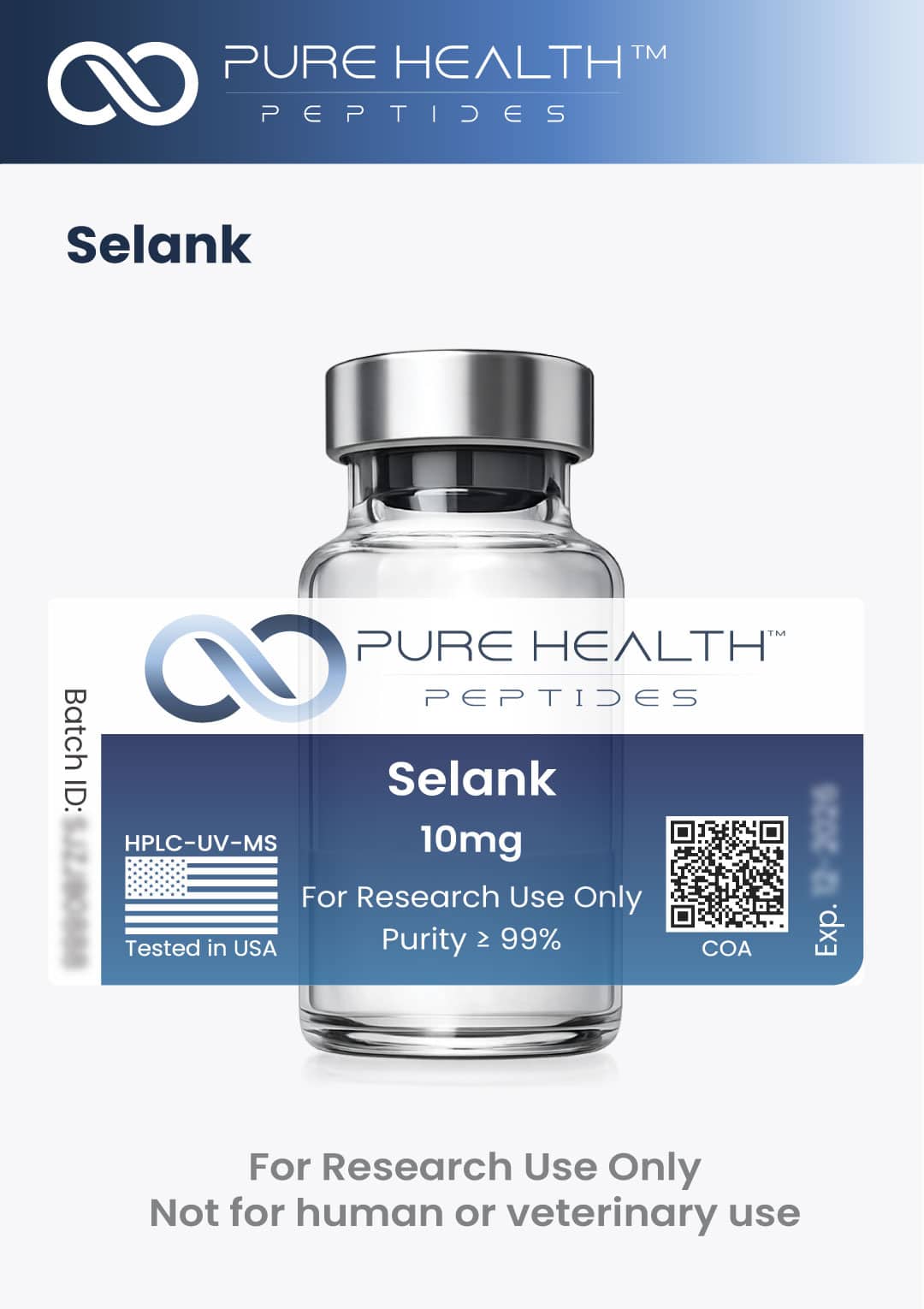
- Pure Health Peptides supplies Selank in two carrier formats: a lyophilized powder Vial (5 mg and 10 mg, HPLC-verified) and a Liquid metered solution sold as Selank TP-7. Every lot is routed through independent, ISO/IEC 17025-accredited testing by Ethos Analytics as the exclusive testing partner.
Introduction
Selank occupies a specific niche in neuropeptide research. It is not a large signaling protein and it is not a small molecule; it is a short synthetic peptide whose design solved a practical problem with its parent compound. Tuftsin, the endogenous tetrapeptide it derives from, is rapidly degraded, which limits its usefulness as a research tool.
Adding a proline-glycine-proline extension to the tuftsin sequence produced a more metabolically stable molecule, and that molecule, Selank, became a reference peptide for studying the pathways involved in anxiety-like behavior without the sedation profile associated with classical anxiolytic drugs.
This article stays within that research frame. It describes the tuftsin lineage and where Selank sits in the family, the structural features that define it, the preclinical and in vitro literature on its pathway effects, and the verification and carrier-format considerations relevant to research material. The mechanistic picture is meaningfully incomplete in the literature, and the article reflects that.
The Selank Peptide Family
Selank belongs to a small group of research peptides built on the tuftsin sequence. Tuftsin itself is an endogenous tetrapeptide, Thr-Lys-Pro-Arg, released by enzymatic cleavage of the heavy chain of immunoglobulin G, and it is historically associated with immune and phagocytic research. Selank extends that four-residue core with a stabilizing Pro-Gly-Pro tail to give the heptapeptide Thr-Lys-Pro-Arg-Pro-Gly-Pro, which resists degradation better than tuftsin while retaining the tuftsin motif.
Around this parent compound sits a set of analogs that apply standard peptide-chemistry modifications for further stability. N-Acetyl Selank Amidate, covered in its own article, adds N-terminal acetylation and C-terminal amidation to the Selank backbone, modifications that are commonly used to slow enzymatic breakdown. For researchers mapping this cluster, the useful distinction is that Selank is the parent heptapeptide, while the acetylated and amidated versions are derivatives designed to alter stability and handling. The broader context for this family sits in the neuropeptides and cognitive signaling overview.
Selank Structure and Pharmacology
Structurally, Selank is defined by its seven-residue sequence and its relationship to tuftsin. The Thr-Lys-Pro-Arg portion is the tuftsin motif, and the Pro-Gly-Pro extension is the stabilizing addition. With a molecular weight near 751.9 g/mol and a compact, proline-rich structure, Selank is a small and well-characterized peptide whose identity is straightforward to confirm by mass spectrometry, which matters for verification because the theoretical mass is unambiguous.
Pharmacologically, Selank is studied as a peptide that acts on several interconnected systems rather than a single receptor. The research literature describes modulation of enkephalin metabolism, in which Selank is reported to influence the activity of enzymes that degrade endogenous enkephalins, thereby affecting the persistence of enkephalin signaling. Alongside this, effects on GABAergic and monoaminergic signaling and on BDNF expression have been reported.
No single, fully validated receptor mechanism accounts for the observed effects, and the literature is best read as describing a peptide that modulates multiple neuroregulatory pathways rather than one defined target.
Anxiolytic Pathway Research in Preclinical Models
The research theme most associated with Selank is anxiolytic-pathway investigation, and the relevant work is preclinical and in vitro. In rodent studies, Selank administration has been associated with reduced anxiety-like behavior, and the interest in the compound stems partly from the observation that these effects were reported without the sedation and dependence liabilities characteristic of benzodiazepine-class anxiolytics.
This makes Selank a useful tool compound for probing how a peptide can influence anxiety-related pathways through a different route than classical GABA-A modulators.
At the molecular level, the literature has focused on gene expression. A rodent study reported that Selank administration affected the expression of a set of genes involved in GABAergic neurotransmission in the rat brain, and a subsequent in vitro study reported comparable effects on GABAergic-neurotransmission genes in IMR-32 neuroblastoma cells, which allowed the gene-expression response to be examined in a defined cellular system.
Separately, Selank has been reported to influence BDNF expression in rodent brain regions, including the hippocampus and prefrontal cortex, in a model of ethanol-related memory impairment. These are research findings in non-human and in vitro systems, the mechanisms are not fully resolved, and none of this describes a clinical use.
Carrier Formats, Verification, and Analytical Reporting
Selank is supplied in two carrier formats, and the distinction matters for how each is analytically verified. The Vial is a lyophilized white powder offered in 5 mg and 10 mg presentations at greater than or equal to 99% HPLC-verified purity, which is the appropriate metric for an isolated raw material.
The Liquid, sold as Selank TP-7, is a pre-formulated aqueous metered solution. Because a finished formulation contains excipients and stabilizers in addition to the peptide, a single purity value does not accurately represent its composition, so identity and assay (content) are reported on its Certificate of Analysis instead, confirming the correct compound and verifying the labeled amount per unit. Selecting the analytically appropriate panel for the material form is the same principle that underpins accredited testing generally.
Underneath both formats is the verification chain. Pure Health Peptides does not manufacture peptide material; production is sourced from qualified third-party manufacturers, and the material is finished and tested domestically, as described on the Manufacturing Process page.
Every lot is routed through independent, ISO/IEC 17025-accredited testing by Ethos Analytics as the exclusive testing partner, and each qualified lot’s Certificate of Analysis is published in the COA Library, across the Vial and Liquid sections, retrievable by batch ID.
For a lyophilized vialed peptide, the appropriate panel extends beyond identity, purity, and quantity to include endotoxin and microbial limits, because contamination can enter downstream of synthesis through handling, lyophilization, vial filling, storage, and transit. The Testing Process page documents how that verification runs, and the same standard applies across the Pure Health Peptides catalog.
The format comparison overview covers how delivery format intersects with research handling.
Where Selank Sits in the Neuropeptide Research Toolkit
For researchers building a neuropeptide toolkit, Selank is a well-defined, stable tuftsin analog with a substantial preclinical literature on anxiety-related pathways and a mechanism that remains an open research question. Its value as a tool compound rests on that combination: a simple, verifiable structure on one side, and a multi-pathway pharmacology that is still being mapped on the other.
As the tuftsin-analog family continues to be studied, comparative work across Selank and its acetylated and amidated derivatives is a natural direction, and it is the direction the September comparison content will explore. In the meantime, Selank remains a reference point for how a short, stabilized peptide can engage neuroregulatory pathways that classical small-molecule anxiolytics reach by different means.
Frequently Asked Questions
What is Selank in structural terms?
Selank is a synthetic heptapeptide with the sequence Thr-Lys-Pro-Arg-Pro-Gly-Pro, molecular formula C33H57N11O9, and a molecular weight of approximately 751.9 g/mol. It is a stabilized analog of the endogenous tetrapeptide tuftsin, extended with a Pro-Gly-Pro tail.
What pathways is Selank studied for in preclinical research?
The literature reports modulation of GABAergic gene expression, effects on BDNF expression in rodent brain regions, and modulation of enkephalin metabolism, alongside reported reductions in anxiety-like behavior in rodent models. The precise mechanism is not fully defined.
How does Selank relate to tuftsin and to N-Acetyl Selank Amidate?
Tuftsin is the endogenous tetrapeptide (Thr-Lys-Pro-Arg) that Selank is built from. N-Acetyl Selank Amidate is a separate derivative that adds N-terminal acetylation and C-terminal amidation to the Selank backbone to alter stability.
What carrier formats is Selank available in?
Two. A lyophilized powder Vial (5 mg and 10 mg, HPLC-verified purity) and a pre-formulated aqueous Liquid metered solution supplied as Selank TP-7.
Why does the Liquid format report identity and assay instead of a purity percentage?
Because a finished formulation contains excipients and stabilizers in addition to the peptide, a single purity value does not represent its overall composition. Identity and assay confirm the correct compound and verify the labeled content, which is the analytically appropriate reporting for a formulated solution.
References
- Najjar VA, Nishioka K. Tuftsin: a natural phagocytosis stimulating peptide. Nature, 1970.
- Volkova A, Shadrina M, et al. Selank Administration Affects the Expression of Some Genes Involved in GABAergic Neurotransmission in the Rat Brain. Frontiers in Pharmacology, 2016.
- Kolomin T, Shadrina M, et al. GABA, Selank, and Olanzapine Affect the Expression of Genes Involved in GABAergic Neurotransmission in IMR-32 Cells. Frontiers in Pharmacology, 2017;8:89.
- Selank, Peptide Analogue of Tuftsin, Protects Against Ethanol-Induced Memory Impairment by Regulating BDNF Content in the Hippocampus and Prefrontal Cortex in Rats. Bulletin of Experimental Biology and Medicine, 2019.
- Kozlovskaya MM, Kozlovskii II, et al. Selank and short peptides of the tuftsin family in the regulation of adaptive behavior in stress. Neuroscience and Behavioral Physiology.
- International Organization for Standardization / International Electrotechnical Commission. ISO/IEC 17025:2017, General requirements for the competence of testing and calibration laboratories.
- United States Pharmacopeia. General Chapter <85> Bacterial Endotoxins Test; <61> and <62> Microbiological Examination of Nonsterile Products.