FOR RESEARCH USE ONLY. The content provided in this article is for educational and informational purposes only and is based on published scientific literature. The compounds discussed are not approved by the FDA for human or veterinary use. They are strictly intended for laboratory research and in vitro experimentation. Pure Health Peptides does not endorse or encourage the use of these products outside of a controlled research setting.
TUDCA, tauroursodeoxycholic acid, is a chemically defined small-molecule bile acid derivative that has become a widely cited research tool in the study of cellular stress. It is not a peptide but the taurine-conjugated form of a naturally occurring bile acid, and its research interest centers on a single, well-characterized property: in preclinical models it has been reported to act as a chemical chaperone, reducing endoplasmic reticulum stress and modulating the unfolded protein response.
This article describes the bile acid chemistry that defines TUDCA, the ER-stress and chaperone research built around it, the hepatobiliary and metabolic research domains it appears in, and how the compound is verified as research material.
Research Snapshot
- TUDCA (tauroursodeoxycholic acid) is a chemically defined small-molecule research compound of the bile acid derivative class. Its molecular formula is C26H45NO6S and its molecular weight is approximately 499.65 g/mol. It is the taurine-conjugated form of ursodeoxycholic acid (UDCA).
- In preclinical research, TUDCA is studied as a chemical chaperone, a small molecule that stabilizes protein folding and thereby reduces endoplasmic reticulum (ER) stress and modulates the unfolded protein response (UPR).
- A foundational study reported that TUDCA acts as an orally active chemical chaperone that reduces ER stress and restores glucose homeostasis in a mouse model, establishing the compound as a reference chaperone in metabolic research (Özcan et al., 2006).
- TUDCA research spans hepatobiliary and metabolic domains, consistent with bile acid biology and the broad involvement of ER-stress signaling across cell types. All such work is preclinical or in vitro.
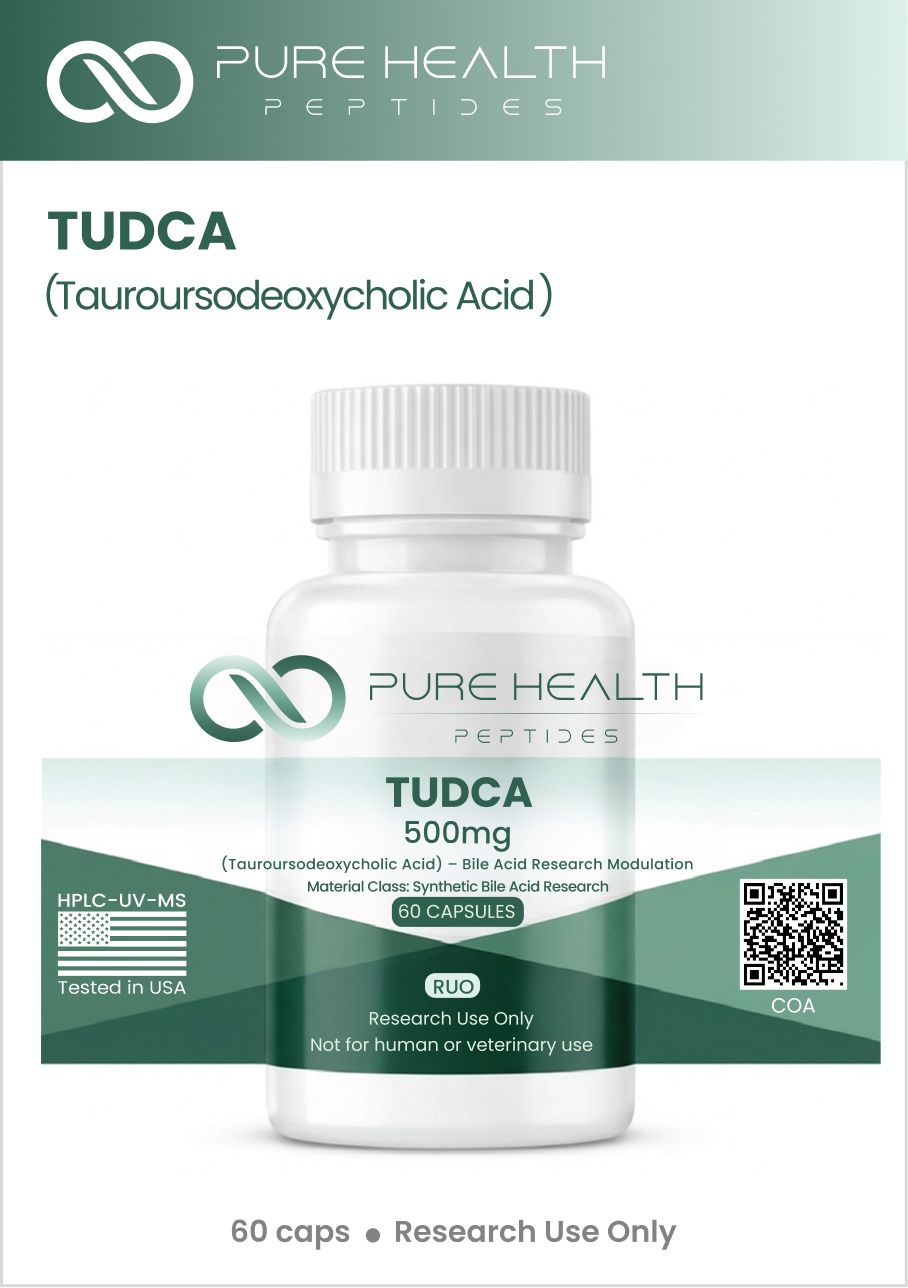
- Pure Health Peptides supplies TUDCA as an encapsulated solid Capsule (500 mg per capsule). The encapsulated format is a containment and presentation method and does not imply a route of administration. Every lot is routed through independent, ISO/IEC 17025-accredited testing by Ethos Analytics as the exclusive testing partner.
Introduction
TUDCA sits at an unusual intersection of classical biochemistry and modern cell biology. As a bile acid, it belongs to a family of molecules long studied for their role in lipid handling and hepatic physiology. As a chemical chaperone, it belongs to a much newer research conversation about how cells manage the stress of misfolded proteins. That dual identity is what makes it a useful research compound: it is chemically simple and well defined, yet it engages a stress-response system that is relevant across many areas of cell biology.
This article keeps to that research frame. It describes the bile acid chemistry that gives TUDCA its properties, the ER-stress and unfolded-protein-response literature that has made it a standard chaperone tool, and the hepatobiliary and metabolic research contexts in which it appears. It does not describe therapeutic use, and it treats the mechanism as the subject of ongoing preclinical investigation rather than a settled clinical story.
Bile Acid Chemistry and the TUDCA Structure
Bile acids are steroid acids synthesized from cholesterol, and their amphipathic structure, combining a hydrophobic steroid core with hydrophilic groups, is what allows them to interact with both lipids and water. Ursodeoxycholic acid (UDCA) is one such bile acid, notable for its relatively hydrophilic character. TUDCA is UDCA conjugated with the amino acid taurine, a modification that increases water solubility and defines the molecule as tauroursodeoxycholic acid, with the molecular formula C26H45NO6S and a molecular weight of approximately 499.65 g/mol.
That conjugation is not a trivial detail. Taurine conjugation shifts the physicochemical behavior of the bile acid, and the hydrophilic profile of TUDCA is part of why it is studied as a comparatively gentle bile acid in experimental systems. As a research material, TUDCA is produced by chemical synthesis and supplied as a defined solid, which makes its identity straightforward to confirm analytically, an important property when a compound is used as a reference in bile acid and small-molecule research.
ER Stress, the Unfolded Protein Response, and Chemical Chaperone Activity
The research theme most associated with TUDCA is its activity as a chemical chaperone. The endoplasmic reticulum is the cellular compartment where many proteins are folded, and when the demand for folding exceeds capacity, misfolded proteins accumulate and trigger a coordinated signaling program known as the unfolded protein response. Sustained ER stress and UPR activation are studied across a wide range of cell-biology contexts, which is why tools that modulate them are valuable.
Chemical chaperones are small molecules that assist protein folding or stabilize proteins in their folded state, and TUDCA has been characterized as one of them. The landmark demonstration came from a study reporting that TUDCA, administered orally, acted as a chemical chaperone that reduced ER stress and restored glucose homeostasis in a mouse model of metabolic dysfunction (Özcan et al., 2006).
Subsequent reviews have consolidated the picture of TUDCA as a bile acid with chaperoning activity that modulates ER-stress and UPR signaling and, in various preclinical models, reduces markers of stress-induced cell death (Kusaczuk, 2019). These are findings in animal and in vitro systems, and the precise molecular details of how TUDCA exerts its chaperone effect remain an active research question.
Hepatobiliary and Metabolic Research Applications
TUDCA’s research footprint follows naturally from its two identities. As a bile acid, it appears in hepatobiliary research, where bile acid biology and ER-stress signaling intersect. Preclinical work has examined TUDCA in models of hepatic stress and injury, reporting modulation of the unfolded protein response in liver-related experimental systems (Malo et al., 2010). As a chemical chaperone with metabolic effects, it appears in metabolic research, consistent with the glucose-homeostasis findings that first brought it to prominence, which is why the compound sits alongside the mitochondrial and metabolic themes covered elsewhere on the blog.
Across both domains, the appropriate framing is mechanistic and preclinical. TUDCA is studied for how it behaves in defined experimental systems, in vitro assays, and animal models, and the research value of the compound lies in that mechanistic reach rather than in any application to disease. Its role in the catalog is as a defined research compound for laboratory investigation, connected to the broader research map through the mitochondrial and cellular energy overview and the metabolic pathways overview.
Carrier Format, Analytical Reporting, and Verification
TUDCA is supplied in a single carrier format, an encapsulated solid Capsule at 500 mg per capsule. As the product page states, the encapsulated format serves solely as a physical containment and presentation method and does not imply any route of administration or intended method of use. Because a capsule is a finished formulation rather than an isolated raw material, a single purity value does not fully represent its composition, so identity and assay (content) are the analytically appropriate measures reported on its Certificate of Analysis, confirming the correct compound and verifying the labeled amount per unit. The capsule format overview covers how encapsulated formats compare to lyophilized powders in research handling.
Underneath the format is the verification chain. Pure Health Peptides does not manufacture the material; production is sourced from qualified third-party manufacturers, and the material is finished and tested domestically, as described on the Manufacturing Process page. Every lot is routed through independent, ISO/IEC 17025-accredited testing by Ethos Analytics as the exclusive testing partner, and each qualified lot’s Certificate of Analysis is published in the COA Library, in the capsule section, retrievable by batch ID. The Testing Process page documents how that verification runs, and the same standard applies to every product in the Pure Health Peptides catalog.
Where TUDCA Sits in Bile Acid and ER-Stress Research
For researchers assembling a toolkit around cellular stress, TUDCA is a well-defined bile acid derivative with a substantial preclinical literature on chemical chaperone activity and a mechanism that is still being resolved at the molecular level. Its value as a research compound comes from that combination: a simple, verifiable structure paired with engagement of the unfolded protein response, a signaling system that reaches across hepatobiliary, metabolic, and broader cell-biology research. As ER-stress research continues to expand, defined chaperone tools like TUDCA remain reference points for probing how cells respond to the burden of misfolded proteins, and the compound’s dual identity as both a bile acid and a chaperone keeps it relevant across more than one research domain.
Frequently Asked Questions
What is TUDCA in chemical terms?
TUDCA is tauroursodeoxycholic acid, the taurine-conjugated form of the bile acid ursodeoxycholic acid. It is a small-molecule research compound with the molecular formula C26H45NO6S and a molecular weight of approximately 499.65 g/mol.
What is a chemical chaperone, and why is TUDCA studied as one?
A chemical chaperone is a small molecule that assists protein folding or stabilizes proteins in their folded state. In preclinical models, TUDCA has been reported to act as a chemical chaperone that reduces endoplasmic reticulum stress and modulates the unfolded protein response.
What research domains does TUDCA appear in?
Primarily hepatobiliary and metabolic research, reflecting its identity as a bile acid and its reported effects on ER-stress signaling. All such work is preclinical or in vitro.
Is TUDCA a peptide?
No. TUDCA is a small-molecule bile acid derivative, which is why it is described as a research compound rather than a research peptide.
What carrier format is TUDCA available in, and how is it verified?
TUDCA is supplied as an encapsulated solid capsule (500 mg per capsule). Because it is a finished formulation, its Certificate of Analysis reports identity and assay, and every lot is routed through independent, ISO/IEC 17025-accredited testing by Ethos Analytics.
References
- Özcan U, Yilmaz E, Özcan L, et al. Chemical chaperones reduce ER stress and restore glucose homeostasis in a mouse model of type 2 diabetes. Science, 2006;313(5790):1137-1140.
- Kusaczuk M. Tauroursodeoxycholate, Bile Acid with Chaperoning Activity: Molecular and Cellular Effects and Therapeutic Perspectives. Cells, 2019;8(12):1471.
- Malo A, et al. Tauroursodeoxycholic acid reduces endoplasmic reticulum stress, trypsin activation, and acinar cell apoptosis. American Journal of Physiology, Gastrointestinal and Liver Physiology, 2010.
- Hofmann AF. The continuing importance of bile acids in liver and intestinal disease. Bile acid biochemistry and physiology (review literature).
- International Organization for Standardization / International Electrotechnical Commission. ISO/IEC 17025:2017, General requirements for the competence of testing and calibration laboratories.