FOR RESEARCH USE ONLY. The content provided in this article is for educational and informational purposes only and is based on published scientific literature. The compounds discussed are not approved by the FDA for human or veterinary use. They are strictly intended for laboratory research and in vitro experimentation. Pure Health Peptides does not endorse or encourage the use of these products outside of a controlled research setting.
AICAR is one of the most widely cited pharmacological tools in the study of cellular energy metabolism. It is not a peptide but a synthetic nucleotide analog, and its research significance comes from a single, well-defined property: once inside a cell, it is converted into a molecule that mimics AMP and activates AMP-activated protein kinase, the enzyme that functions as the cell’s central energy sensor. That mechanism made AICAR the reference method for switching on AMPK in intact cells, and it is the reason the compound remains a standard tool in metabolic and energy-signaling research.
This article describes what AICAR is, the AMP-mimetic mechanism by which it activates AMPK, the energy-sensing and exercise-mimetic pathway research it has been used in, and the verification infrastructure relevant to research material.
Research Snapshot
- AICAR (5-aminoimidazole-4-carboxamide ribonucleoside, also written AICA riboside) is a synthetic nucleotide analog produced by chemical synthesis, not a peptide. It is studied as a cell-permeable pharmacological activator of AMP-activated protein kinase (AMPK).
- Inside the cell, AICAR is phosphorylated to its monophosphate form, ZMP, which mimics AMP and thereby activates AMPK without a large change in the cell’s actual AMP-to-ATP ratio (Corton et al., 1995).
- AMPK is the cell’s central energy sensor: when activated it shifts metabolism toward energy-generating pathways, and it has been described as a regulator of nearly all aspects of cellular energy homeostasis (Hardie, 2011).
- In rodent studies, AICAR-driven AMPK activation in skeletal muscle has been associated with increased fatty acid oxidation and glucose uptake (Merrill et al., 1997), and AICAR has been characterized as an exercise-mimetic research tool in preclinical models (Narkar et al., 2008).
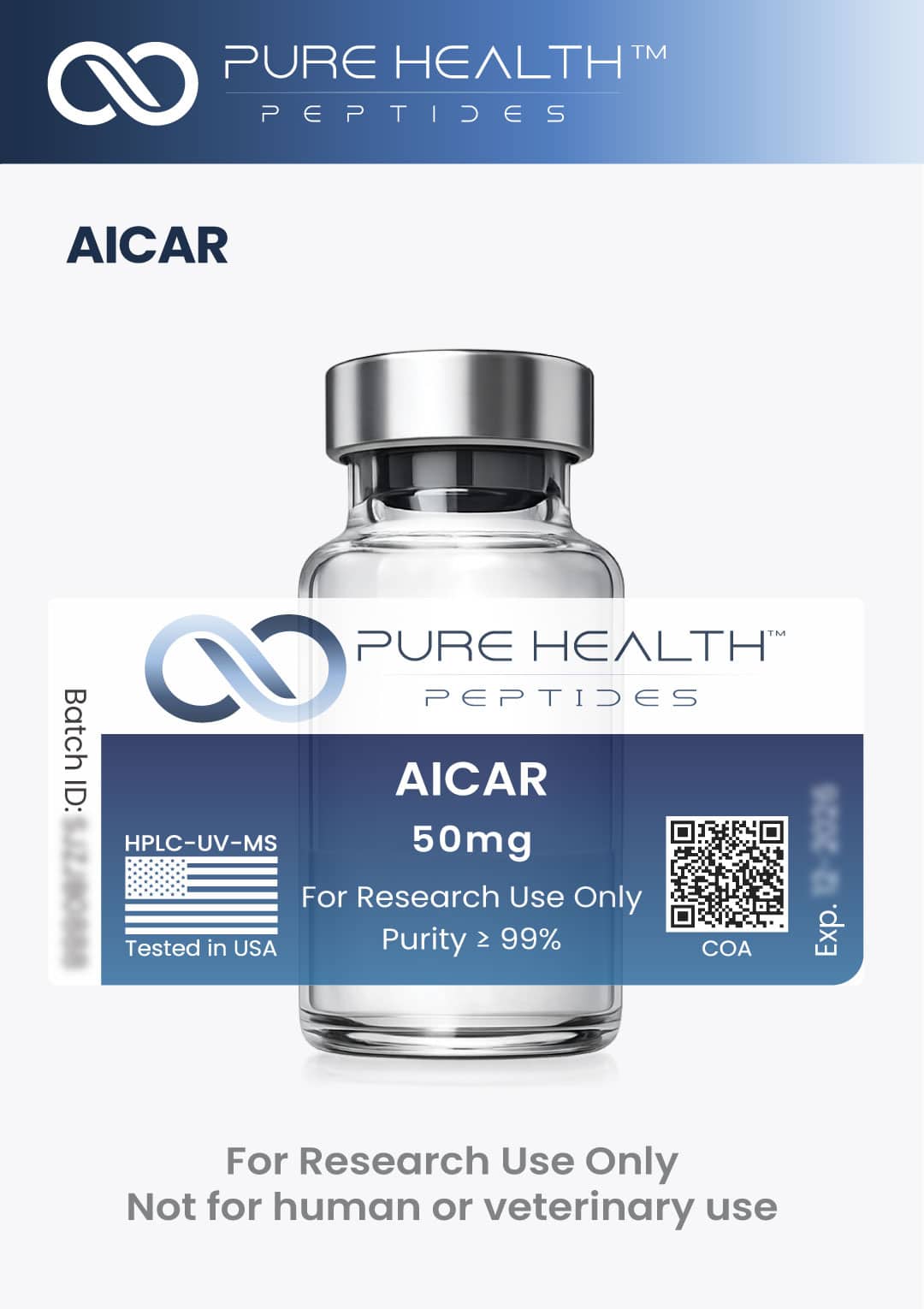
- Pure Health Peptides offers AICAR as a Vial format research compound. Material is sourced from qualified third-party manufacturers; the verification chain, with every lot routed through independent, ISO/IEC 17025-accredited testing by Ethos Analytics as Pure Health Peptides’ exclusive testing partner, is what Pure Health Peptides owns and stands behind across the catalog.
Introduction
AICAR occupies an unusual place in metabolic research. It is not a signaling peptide and it is not a hormone. It is a small synthetic molecule whose entire research value rests on a precise biochemical trick: it is taken up by cells and converted into a compound that impersonates AMP, the cell’s low-energy signal. Because AMP is one of the direct activators of AMP-activated protein kinase, that impersonation switches the kinase on. For researchers who needed a reliable way to study AMPK in living cells, AICAR became the standard method, and much of what is understood about AMPK signaling was mapped using it.
This article keeps to that mechanism and the research built on it. The AMP-mimetic conversion, the energy-sensing role of AMPK, and the downstream metabolic and exercise-mimetic research are all well characterized in the published literature, and they are the appropriate frame for research use of this compound.
AICAR Structure and the AMP-Mimetic Mechanism
AICAR is a nucleoside: a ribose sugar joined to the AICA base (5-aminoimidazole-4-carboxamide). It is a natural intermediate in the purine biosynthesis pathway, which is part of why cells possess the machinery to take it up and process it.
The mechanism that defines AICAR in research is what happens after uptake. Inside the cell, AICAR is phosphorylated by adenosine kinase to its monophosphate form, commonly called ZMP. ZMP is a structural mimic of AMP, and it engages the same regulatory sites on AMP-activated protein kinase that AMP does. The result is that AMPK is activated as though the cell’s energy charge had fallen, even when the actual AMP-to-ATP ratio has not changed substantially. This property, first characterized in intact hepatocytes, is what established AICAR as a specific pharmacological method for activating AMPK in cells (Corton et al., 1995).
That distinction matters for research design. Because AICAR works through ZMP rather than by depleting cellular energy directly, it lets researchers isolate the consequences of AMPK activation from the broader stress of genuine energy depletion. It is worth noting that ZMP is not a perfect and exclusive AMPK activator, and the literature also documents AMPK-independent effects of AICAR, which is part of why careful research design and defined material are important when the compound is used.
AMPK: The Cellular Energy Sensor
To understand why AICAR is useful, the receptor of interest is really an enzyme: AMP-activated protein kinase. AMPK functions as the cell’s fuel gauge. It monitors the ratio of AMP and ADP to ATP, and when that ratio rises, signaling that energy is running low, AMPK switches on. Once active, it broadly shifts the cell away from energy-consuming synthetic processes and toward energy-producing catabolic ones.
The reach of this switch is wide. AMPK has been characterized as an energy sensor that regulates nearly all aspects of cellular energy homeostasis, acting on lipid metabolism, glucose uptake, mitochondrial function, and cell growth signaling (Hardie, 2011). This breadth is exactly why a clean pharmacological activator became so valuable: AICAR gave researchers a way to engage a master regulatory node and then study what moved downstream. Much of the foundational mapping of AMPK’s role in cellular energy pathways was carried out with AICAR as the activating tool.
Exercise-Mimetic and Metabolic Pathway Research
The downstream consequences of AMPK activation are where AICAR’s most cited research sits, and the two recurring themes are skeletal-muscle metabolism and the exercise-mimetic concept.
In skeletal muscle, AMPK activation drives a metabolic shift toward fuel oxidation. In rodent studies, perfusion of muscle with AICAR activated AMPK, reduced the activity of acetyl-CoA carboxylase, and was associated with increased fatty acid oxidation and glucose uptake (Merrill et al., 1997). Because contraction and exercise are themselves natural activators of AMPK in muscle, this positioned AICAR as a way to engage part of the same signaling pathway pharmacologically, in a research setting, without contraction.
That line of work led to the exercise-mimetic framing. In a widely cited preclinical study, sedentary mice given AICAR showed measurable increases in running endurance relative to untreated controls, alongside gene-expression changes in oxidative muscle pathways (Narkar et al., 2008). Reported strictly as a preclinical finding, this is what made AICAR a reference tool for studying whether the metabolic adaptations associated with endurance can be engaged through the AMPK pathway in research models. This research situates AICAR alongside other compounds studied for their effects on metabolic pathway modulation and mitochondrial energy signaling, including the ERR-pathway compound SLU-PP-332 and the mitochondrial-derived peptide MOTS-c. Across this cluster, the framing is mechanistic, how the energy-sensing pathway is engaged and how metabolism responds in preclinical models, rather than any statement about outcomes outside a controlled research setting.
Sourcing, Verification, and Lot-Level Testing
AICAR in the Pure Health Peptides catalog is sourced from qualified third-party manufacturers as strictly compliant research material in Vial format. Pure Health Peptides does not manufacture material directly. What Pure Health Peptides owns and stands behind across the catalog is the third-party verification chain.
Every production lot is routed through independent, accredited testing by its exclusive testing partner Ethos Analytics under ISO/IEC 17025 accreditation, with the result published as a lot-specific Certificate of Analysis. The standard COA panel reports compound identity verified by HPLC and mass spectrometry per USP <621>, purity, quantity, heavy metals screening by ICP-MS per USP <233>, endotoxin testing per USP <85>, and microbiological screening per USP <61> and USP <62>. Lot-level COAs are accessible through the publicly browsable COA Library (Vial COAs | Capsule COAs | Liquid COAs).
For a small synthetic molecule like AICAR, identity confirmation by mass spectrometry is straightforward because the theoretical mass is unambiguous, which is one reason lot-level verification is a meaningful signal of what the material actually is.
The Direction of AMPK and Exercise-Mimetic Research
AMPK research remains active, and interest in pharmacological activators of the energy-sensing pathway has only grown as its role across metabolism has become clearer. AICAR’s place in that landscape is as the long-standing reference activator: the tool that established much of what is known about how the pathway behaves when it is switched on. Newer and more selective AMPK activators continue to be developed, but they are routinely benchmarked against the body of work built with AICAR.
The compound also anchors a broader research cluster organized around cellular energy and metabolic signaling, sitting alongside metabolic pathway and mitochondrial-energy compounds studied for related mechanisms. Across that cluster, the common thread is how cells sense and manage energy, and how that regulation can be probed pharmacologically in research models.
Quality verification is foundational to all of it. Mechanistic and pathway studies depend on confidence that the compound under investigation is exactly what the label states and free of confounding contaminants, and the lot-level COA infrastructure described above is built to support that requirement.
FOR RESEARCH USE ONLY. The content provided in this article is for educational and informational purposes only and is based on published scientific literature. The compounds discussed are not approved by the FDA for human or veterinary use. They are strictly intended for laboratory research and in vitro experimentation. Pure Health Peptides does not endorse or encourage the use of these products outside of a controlled research setting.
Frequently Asked Research Questions
What is AICAR, and what is its mechanism?
AICAR (5-aminoimidazole-4-carboxamide ribonucleoside, or AICA riboside) is a synthetic nucleotide analog, not a peptide. Inside a cell it is phosphorylated to ZMP, a molecule that mimics AMP and activates AMP-activated protein kinase (AMPK). This makes AICAR a cell-permeable pharmacological tool for switching on AMPK in research models (Corton et al., 1995).
What is AMPK, and why does it matter in research?
AMPK is the cell’s central energy sensor. It responds to a falling energy charge by shifting metabolism toward energy-producing pathways, and it has been described as a regulator of nearly all aspects of cellular energy homeostasis (Hardie, 2011). AICAR is valued because it activates this master regulator, letting researchers study what happens downstream.
Why is AICAR described as an exercise mimetic?
Because exercise and muscle contraction naturally activate AMPK, and AICAR engages part of the same pathway pharmacologically. In a preclinical study, sedentary mice given AICAR showed increased running endurance relative to controls (Narkar et al., 2008). The term describes a research observation in animal models, not an outcome outside a controlled research setting.
Is AICAR a peptide?
No. AICAR is a synthetic nucleotide analog produced by chemical synthesis rather than amino acid assembly. It is supplied as a solid research material and is referred to as a research compound rather than a research peptide.
How is AICAR identity verified at the lot level?
Compound identity is confirmed by HPLC coupled with mass spectrometry per USP <621>, with each lot routed through independent, accredited testing by its exclusive testing partner Ethos Analytics under ISO/IEC 17025 accreditation, and the result reported on a lot-specific Certificate of Analysis.
References
Scientific Literature
- Corton, J.M., Gillespie, J.G., Hawley, S.A., & Hardie, D.G. (1995). 5-Aminoimidazole-4-carboxamide ribonucleoside: A specific method for activating AMP-activated protein kinase in intact cells? European Journal of Biochemistry, 229(2), 558–565.
- Merrill, G.F., Kurth, E.J., Hardie, D.G., & Winder, W.W. (1997). AICA riboside increases AMP-activated protein kinase, fatty acid oxidation, and glucose uptake in rat muscle. American Journal of Physiology, 273(6), E1107–E1112.
- Narkar, V.A., Downes, M., Yu, R.T., Embler, E., Wang, Y.X., Banayo, E., et al. (2008). AMPK and PPARδ agonists are exercise mimetics. Cell, 134(3), 405–415.
- Hardie, D.G. (2011). AMP-activated protein kinase: An energy sensor that regulates all aspects of cell function. Genes & Development, 25(18), 1895–1908.
Regulatory and Pharmacopeial Standards
- International Organization for Standardization. ISO/IEC 17025:2017, General requirements for the competence of testing and calibration laboratories.
- United States Pharmacopeia. Chapter <621>: Chromatography.
- United States Pharmacopeia. Chapter <233>: Elemental Impurities, Procedures.
- United States Pharmacopeia. Chapter <85>: Bacterial Endotoxins Test.
- United States Pharmacopeia. Chapter <61>: Microbiological Examination of Nonsterile Products, Microbial Enumeration Tests.
- United States Pharmacopeia. Chapter <62>: Microbiological Examination of Nonsterile Products, Tests for Specified Microorganisms.