FOR RESEARCH USE ONLY. The content provided in this article is for educational and informational purposes only and is based on published scientific literature. The compounds discussed are not approved by the FDA for human or veterinary use. They are strictly intended for laboratory research and in vitro experimentation. Pure Health Peptides does not endorse or encourage the use of these products outside of a controlled research setting.
GHK-Cu occupies a well-established position in dermal and tissue-signaling research. The tripeptide-copper complex has been the subject of published research for over five decades, with mechanistic literature accumulating around its role in gene expression regulation, extracellular matrix biology, and copper-mediated cellular signaling. The compound’s combination of a small peptide backbone with a coordinated copper ion gives it dual structural identity, both as a signaling peptide and as a copper-delivery vehicle, and that combination underlies much of its observed research activity.
This article describes the structural and coordination chemistry that defines GHK-Cu, the gene expression and signaling pathway research the compound has been used to investigate, the dermal and extracellular matrix research applications that constitute its largest research literature footprint, and the verification infrastructure relevant to research material.
Research Snapshot
- GHK-Cu is a copper-bound tripeptide consisting of the amino acid sequence glycyl-L-histidyl-L-lysine (GHK) complexed with a divalent copper ion (Cu²⁺). The peptide was first identified in human plasma in the 1970s by Loren Pickart and has since become one of the more extensively studied copper-binding peptides in research literature.
- Endogenous GHK levels in human plasma decline measurably with age, a finding that has shaped a substantial portion of the research interest in the compound (Pickart, Vasquez-Soltero & Margolina, 2015).
- Mechanistic research has investigated GHK-Cu as a regulator of gene expression in dermal fibroblast research models, with broad effects observed across genes involved in extracellular matrix remodeling, copper homeostasis, antioxidant defense, and tissue signaling (Pickart & Margolina, 2018).
- GHK-Cu in the Pure Health Peptides catalog appears as a standalone Vial format compound and as a component of three blend formulations: the GLOW blend (with BPC-157 and TB-500), the GLOW-Plus blend (which adds Thymosin Alpha-1 to GLOW), and the KLOW blend (which adds KPV to the BPC-157 / GHK-Cu / TB-500 base).
- Material is sourced from qualified third-party manufacturers; the verification chain, independent lot-level testing by Ethos Analytics under ISO/IEC 17025 accreditation, is what Pure Health Peptides owns and stands behind across the catalog.
Introduction
GHK-Cu occupies a well-established position in dermal and tissue-signaling research. The tripeptide-copper complex has been the subject of published research for over five decades, with mechanistic literature accumulating around its role in gene expression regulation, extracellular matrix biology, and copper-mediated cellular signaling. The compound’s combination of a small peptide backbone with a coordinated copper ion gives it dual structural identity, both as a signaling peptide and as a copper-delivery vehicle, and that combination underlies much of its observed research activity.
This article describes the structural and coordination chemistry that defines GHK-Cu, the gene expression and signaling pathway research the compound has been used to investigate, the dermal and extracellular matrix research applications that constitute its largest research literature footprint, and the verification infrastructure relevant to research material.
GHK-Cu Structure and Copper Coordination Chemistry
The GHK tripeptide consists of three amino acid residues: glycine at the N-terminus, histidine in the middle position, and lysine at the C-terminus. The peptide adopts a structural configuration in which the histidine imidazole nitrogen, the glycine amino terminus, and the deprotonated amide nitrogen of the glycine-histidine peptide bond all participate in coordinating a divalent copper ion. The resulting square-planar coordination geometry produces a stable copper-peptide complex with characteristic spectroscopic properties.
The high affinity of GHK for copper(II) is a defining feature of the molecule. The peptide selectively binds copper over other divalent metal ions present in physiological conditions, and the resulting complex is stable across a relevant pH range. This selectivity has positioned GHK as a candidate research tool for studying copper trafficking and copper-dependent cellular processes, separately from its direct signaling effects.
The AHK-Cu Structural Relative
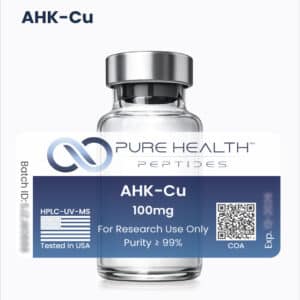
GHK belongs to a small family of structurally related copper-binding tripeptides. AHK (alanyl-histidyl-lysine), which substitutes alanine for glycine at the N-terminal position, is the closest structural relative and forms a similar copper complex. AHK-Cu has been characterized in dermal research literature in parallel with GHK-Cu and appears in select modules of the Pure Topical Research System, specifically Topical System D, where it is the primary active, and Topical System E, where it is a co-active.
Gene Expression and Signaling Pathway Research
A defining feature of GHK-Cu research has been the breadth of gene expression effects observed in dermal fibroblast and related cellular models. Transcriptomic studies have characterized the compound as influencing the expression of a large number of genes, published analyses have reported effects on the expression of more than four thousand human genes, across the directional categories studied, with notable enrichment in pathways related to extracellular matrix remodeling, cellular proliferation, antioxidant response, and copper homeostasis.
This breadth has positioned GHK-Cu as something closer to a transcriptional resetting agent than a narrowly defined receptor agonist. Rather than acting through a single defined receptor and triggering one signaling cascade, the compound has been characterized as producing coordinated shifts across multiple gene expression programs simultaneously. The upstream mechanism by which this happens has been a subject of mechanistic investigation, with hypotheses ranging from direct nuclear localization of the copper complex to indirect signaling via copper-dependent enzyme activity (notably superoxide dismutase 1, SOD1) and downstream transcription factor modulation.
Antioxidant Signaling and Copper-Dependent Enzymes
Antioxidant signaling has been a particularly active line of mechanistic inquiry. GHK-Cu has been investigated as an activator of SOD1 and as a modulator of the Nrf2-Keap1 antioxidant response pathway in cellular models. The interaction between copper delivery and antioxidant enzyme activity reflects the broader theme in GHK-Cu research: that the peptide’s role as a copper-delivery vehicle and its role as a signaling molecule are not cleanly separable.
Dermal and Extracellular Matrix Research Applications
The largest body of GHK-Cu research literature has focused on dermal and extracellular matrix (ECM) biology. In dermal fibroblast research models, the compound has been investigated for effects on collagen synthesis, glycosaminoglycan production, decorin expression, and matrix metalloproteinase regulation. The pattern of observed effects has been characterized as supporting ECM turnover and remodeling, increasing the expression of structural matrix components while modulating the balance between matrix-building and matrix-degrading enzymes.
Wound Healing and Adjacent Research Domains
In wound healing research models, GHK-Cu has been investigated across rodent and in vitro systems for effects on angiogenesis, fibroblast migration, and tissue repair signaling. The mechanistic research in this area has connected the compound’s activity to copper-dependent angiogenic factors and to its broader gene expression effects on cellular proliferation and ECM remodeling.
Hair follicle research has been another adjacent area of investigation. Dermal papilla cell models exposed to GHK-Cu have been characterized for changes in proliferation, gene expression, and signaling related to the hair growth cycle. The mechanistic literature in this area is smaller than the fibroblast and wound healing literature but has been a consistent thread in the GHK-Cu research footprint.
Across these dermal applications, the research narrative has built a relatively coherent picture: GHK-Cu acts at the intersection of copper delivery, gene expression regulation, and ECM signaling, with the net effect in dermal research models being one of coordinated support for tissue remodeling and matrix function. Skin penetration of the copper-peptide complex has also been characterized in vitro, providing context for the formulation work behind topical research applications.
GHK-Cu in PHP Blend Formulations and Verification
GHK-Cu in the Pure Health Peptides catalog appears in four product configurations. The standalone Vial format provides the copper-peptide complex as the sole active compound. The GLOW blend combines GHK-Cu with BPC-157 and TB-500 in a Vial format multi-peptide formulation. The GLOW-Plus blend adds Thymosin Alpha-1 to the GLOW composition, producing a four-component blend. The KLOW blend combines BPC-157, GHK-Cu, TB-500, and KPV into a different four-component formulation. Blend products carry their own verification considerations: each individual component must be confirmed independently for identity and content, and the formulation as a whole must be verified for stability and absence of cross-component interference.
Sourcing and Lot-Level Verification
GHK-Cu material is sourced from qualified third-party manufacturers as strictly compliant research material. Pure Health Peptides does not manufacture peptide material directly. What Pure Health Peptides owns and stands behind across the catalog is the third-party verification chain.
Every production lot is independently tested by Ethos Analytics under ISO/IEC 17025 accreditation, with the result published as a lot-specific Certificate of Analysis. The standard COA panel reports peptide identity verified by HPLC and mass spectrometry per USP <621>, copper content quantification, purity, heavy metals screening by ICP-MS per USP <233>, endotoxin testing per USP <85>, and microbiological screening per USP <61> and USP <62>. Lot-level COAs are accessible through the publicly browsable COA Library (Vial COAs | Capsule COAs | Liquid COAs), and the same documentation discipline applies whether the compound is supplied as a standalone Vial or as a component of a blend formulation.
The Direction of GHK-Cu Research
GHK-Cu research continues to develop across the dermal, ECM, gene expression, and copper trafficking domains. The breadth of the compound’s transcriptional footprint remains an active subject of mechanistic inquiry, with research focused on identifying the upstream events that translate copper-peptide exposure into coordinated changes across multiple gene expression programs. The compound also continues to serve as a reference tool for copper-dependent signaling research more broadly, and its structural relationship to AHK-Cu and other copper-binding tripeptides positions it within a broader category of research tools for studying copper coordination chemistry in biological systems.
FOR RESEARCH USE ONLY. The content provided in this article is for educational and informational purposes only and is based on published scientific literature. The compounds discussed are not approved by the FDA for human or veterinary use. They are strictly intended for laboratory research and in vitro experimentation. Pure Health Peptides does not endorse or encourage the use of these products outside of a controlled research setting.
Frequently Asked Research Questions
What is GHK-Cu, and where does it come from?
GHK-Cu is a copper-bound tripeptide consisting of the amino acids glycine, histidine, and lysine, complexed with a divalent copper ion. The peptide was first identified in human plasma in the 1970s and is found endogenously at concentrations that decline measurably with age.
How does GHK coordinate copper?
The histidine imidazole nitrogen, the glycine amino terminus, and the deprotonated amide nitrogen of the glycine-histidine peptide bond all participate in coordinating the copper(II) ion, producing a stable square-planar coordination geometry. The high selectivity of GHK for copper over other divalent metal ions is a defining structural feature.
What is the proposed mechanism of action of GHK-Cu in dermal research models?
GHK-Cu has been characterized as producing broad effects on gene expression in dermal fibroblast models, with shifts observed across pathways including extracellular matrix remodeling, cellular proliferation, antioxidant response, and copper homeostasis. The upstream mechanism is hypothesized to involve a combination of direct gene-regulatory effects and copper-dependent enzyme modulation.
How does GHK-Cu relate to AHK-Cu?
AHK-Cu (alanyl-histidyl-lysine bound to copper) is the closest structural relative of GHK-Cu, substituting alanine for glycine at the N-terminal position. Both compounds form similar copper coordination geometries and have been characterized in dermal research literature. AHK-Cu appears in Topical System D (primary active) and Topical System E (co-active) of the Pure Topical Research System.
What carrier formats and blend formulations is GHK-Cu available in at Pure Health Peptides?
GHK-Cu is offered as a standalone Vial format and as a component of three blend formulations: the GLOW blend (with BPC-157 and TB-500), the GLOW-Plus blend (which adds Thymosin Alpha-1 to GLOW), and the KLOW blend (which adds KPV to the BPC-157 / GHK-Cu / TB-500 base). All four configurations follow the standard lot-level COA discipline applied across the Pure Health Peptides catalog.
Where is GHK-Cu in the Pure Health Peptides catalog sourced from?
GHK-Cu is sourced from qualified third-party manufacturers as strictly compliant research material. Pure Health Peptides does not manufacture peptide material directly. The third-party verification chain, independent ISO/IEC 17025-accredited testing of every production lot, is what Pure Health Peptides owns and stands behind.
References
Scientific Literature
- Pickart, L. (2008). The human tri-peptide GHK and tissue remodeling. Journal of Biomaterials Science, Polymer Edition, 19(8), 969–988.
- Pickart, L., Vasquez-Soltero, J.M., & Margolina, A. (2015). GHK Peptide as a Natural Modulator of Multiple Cellular Pathways in Skin Regeneration. BioMed Research International, 2015, 648108.
- Pickart, L., & Margolina, A. (2018). Regenerative and Protective Actions of the GHK-Cu Peptide in the Light of the New Gene Data. International Journal of Molecular Sciences, 19(7), 1987.
- Maquart, F.X., et al. (1988). Stimulation of collagen synthesis in fibroblast cultures by the tripeptide-copper complex glycyl-L-histidyl-L-lysine-Cu²⁺. FEBS Letters, 238(2), 343–346.
- Hostynek, J.J., Dreher, F., & Maibach, H.I. (2011). Human skin penetration of a copper tripeptide in vitro as a function of skin layer. Inflammation Research, 60(1), 79–86.
Regulatory and Pharmacopeial Standards
- United States Pharmacopeia. Chapter <621>: Chromatography.
- United States Pharmacopeia. Chapter <233>: Elemental Impurities, Procedures.
- United States Pharmacopeia. Chapter <85>: Bacterial Endotoxins Test.
- United States Pharmacopeia. Chapter <61>: Microbiological Examination of Nonsterile Products, Microbial Enumeration Tests.
- United States Pharmacopeia. Chapter <62>: Microbiological Examination of Nonsterile Products, Tests for Specified Microorganisms.
- International Organization for Standardization. ISO/IEC 17025:2017, General requirements for the competence of testing and calibration laboratories.