FOR RESEARCH USE ONLY. The content provided in this article is for educational and informational purposes only and is based on published scientific literature. The compounds discussed are not approved by the FDA for human or veterinary use. They are strictly intended for laboratory research and in vitro experimentation. Pure Health Peptides does not endorse or encourage the use of these products outside of a controlled research setting.
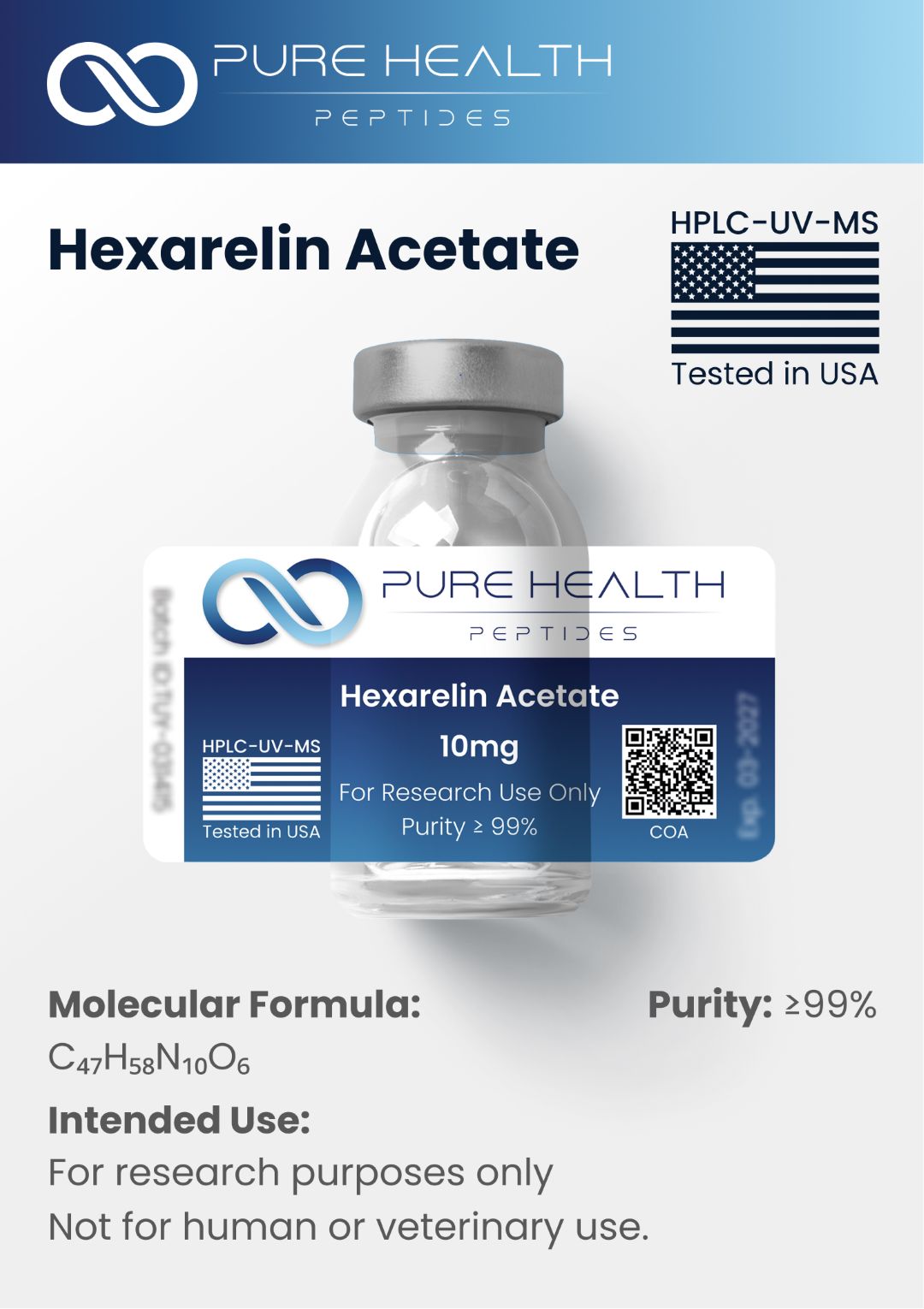
Hexarelin Acetate is a synthetic hexapeptide of the growth hormone secretagogue class, a group of small peptides defined by their interaction with the growth hormone secretagogue receptor. Its research interest is unusually two-sided: alongside the receptor pharmacology it shares with related secretagogue peptides, hexarelin has a distinct body of literature centered on a second receptor, CD36, and on cardiac research. This article describes the secretagogue peptide class, the structure and acetate salt form of hexarelin, the receptor pharmacology that defines it, and the preclinical research directions that make it a distinctive tool compound.
Research Snapshot
- Hexarelin is a synthetic hexapeptide with the sequence His-D-2-methyl-Trp-Ala-Trp-D-Phe-Lys-NH2, molecular formula C47H58N12O6, and a molecular weight of approximately 887.04 g/mol. It is supplied as the acetate salt.
- It belongs to the growth hormone secretagogue (GHS) peptide class and is studied for its interaction with the growth hormone secretagogue receptor (GHS-R) in preclinical and in vitro systems.
- Beyond GHS-R, hexarelin is characterized in the literature for binding CD36, a scavenger receptor, which underlies a distinct line of cardiac and cardiovascular research (Bodart et al., 2002; Demers et al., 2004).
- In preclinical models, hexarelin has been studied in relation to growth hormone secretagogue receptor signaling, the hypothalamic-pituitary-adrenal axis, and cardioprotective pathways (Korbonits et al., 1999; Mao et al., 2017). These are research findings in animal and cellular systems.
- Pure Health Peptides supplies the compound as a lyophilized Vial, offered under two SKUs of the same molecule, Hexarelin Acetate and Hexarelin. Every lot is routed through independent, ISO/IEC 17025-accredited testing by Ethos Analytics as the exclusive testing partner.
Introduction
Hexarelin sits within a well-defined family of research peptides, the growth hormone secretagogues, but it occupies a distinctive position inside that family. Where much of the interest in the secretagogue class centers on a single receptor system, hexarelin is characterized in the literature for engaging two: the growth hormone secretagogue receptor that names the class, and CD36, a scavenger receptor with roles in cardiovascular biology. That dual receptor profile is what makes hexarelin a useful and specific tool compound for probing questions that a single-receptor peptide could not address.
This article stays within a research frame. It describes the secretagogue peptide class and where hexarelin fits, the hexapeptide structure and the acetate salt form in which it is supplied, the receptor pharmacology that defines its activity, and the preclinical research directions, including the cardiac literature, that distinguish it. The mechanistic picture is treated as the subject of ongoing preclinical investigation, and the article does not describe any applied or non-research use.
The Growth Hormone Secretagogue Peptide Class
The growth hormone secretagogues are a class of compounds that interact with the growth hormone secretagogue receptor, a G-protein-coupled receptor that became a major focus of endocrine research. Within the peptide members of this class sit the growth-hormone-releasing peptides, a group of small synthetic peptides that includes the GHRP series and hexarelin. These are compact molecules, typically five or six residues, engineered for stable interaction with the receptor.
Hexarelin is one of the more studied members of this group. As a synthetic hexapeptide built with non-standard amino acid residues, it was designed for metabolic stability and defined receptor interaction, which is part of why it became a reference secretagogue peptide in research. Its membership in this class is the starting point for understanding it, but the reason it remains a distinct research subject is what it does beyond the shared class receptor, which the pharmacology section addresses.
Hexarelin Structure and the Acetate Salt Form
Structurally, hexarelin is a hexapeptide with the sequence His-D-2-methyl-Trp-Ala-Trp-D-Phe-Lys-NH2. The presence of D-amino acids and a methylated tryptophan residue is characteristic of the growth-hormone-releasing peptide design, where non-standard residues are used to resist enzymatic degradation and to hold a defined conformation at the receptor. The molecule has the formula C47H58N12O6 and a molecular weight of approximately 887.04 g/mol.
As a research material, hexarelin is supplied as the acetate salt, which is the conventional and stable form for a basic peptide of this kind. The salt form supports handling and stability without altering the peptide sequence, and the exact salt-adjusted mass is confirmed per lot on the Certificate of Analysis. Because the peptide is prepared by solid-phase peptide synthesis to a defined sequence, its identity is straightforward to confirm by mass spectrometry against the theoretical mass, which is the basis of lot-level verification.
Receptor Pharmacology: GHS-R and the CD36 Connection
The pharmacology that defines hexarelin operates through two receptor systems. The first is the growth hormone secretagogue receptor (GHS-R), the receptor that names the class. Hexarelin is studied as a ligand at this receptor in preclinical and in vitro systems, where secretagogue peptides have been characterized for their receptor-binding and downstream signaling behavior. In rodent models, growth hormone secretagogue receptor engagement by this class has been associated with stimulation of growth hormone release, a research observation in animal systems rather than an applied outcome.
The second receptor system is what sets hexarelin apart. Research identified CD36, a scavenger receptor expressed in cardiovascular tissue, as a binding partner for growth-hormone-releasing peptides including hexarelin, and mapped the peptide binding site on the receptor (Bodart et al., 2002; Demers et al., 2004). This CD36 interaction is distinct from the GHS-R pathway and is the basis for the cardiovascular line of hexarelin research. The existence of two receptor targets means that hexarelin cannot be understood as a single-pathway secretagogue, and careful research design is needed to attribute an observed effect to one receptor system or the other.
Preclinical Research Directions
The two-receptor profile opens two research directions. Through the growth hormone secretagogue receptor, hexarelin has been used to study secretagogue receptor signaling and its connections to broader endocrine axes. One study characterized hexarelin in relation to the hypothalamic-pituitary-adrenal axis, reporting an interaction with arginine vasopressin signaling (Korbonits et al., 1999), which illustrates how a secretagogue peptide can be a tool for probing endocrine cross-talk in animal models.
Through CD36, hexarelin has been studied in a cardiovascular context. Preclinical work has examined the compound in models of cardiac stress, including a study reporting cardioprotective effects in rat cardiomyocytes subjected to ischemia and reperfusion injury, framed through an interleukin-1 signaling pathway (Mao et al., 2017). This cardiac research is the most distinctive part of the hexarelin literature and is the reason the compound is of interest well beyond the secretagogue receptor that defines its class. As with all of this work, the findings are preclinical and mechanistic, and the appropriate framing is the receptor biology rather than any applied use.
Carrier Format and Verification
Hexarelin is supplied in a single carrier format, a lyophilized Vial, and Pure Health Peptides lists it under two SKUs of the same molecule: Hexarelin Acetate, named for the salt form, and Hexarelin, the same peptide under its base name. Both are lyophilized white powders at high HPLC-verified purity. There is no capsule, liquid, or topical format for this compound.
Underneath the format is the verification chain. Pure Health Peptides does not manufacture the material; production is sourced from qualified third-party manufacturers, and the material is finished and tested domestically, as described on the Manufacturing Process page. Every lot is routed through independent, ISO/IEC 17025-accredited testing by Ethos Analytics as the exclusive testing partner, and each qualified lot’s Certificate of Analysis is published in the COA Library, in the vial section, retrievable by batch ID.
For a lyophilized vialed peptide, the appropriate panel extends beyond identity, purity, and quantity to include endotoxin and microbial limits, because contamination can enter downstream of synthesis through handling, lyophilization, vial filling, storage, and transit. The Testing Process page documents how that verification runs, and the same standard applies to every product in the Pure Health Peptides catalog.
Where Hexarelin Sits in Secretagogue Research
For researchers studying the growth hormone secretagogue class, hexarelin is a defined, well-characterized hexapeptide with an unusually broad receptor profile. Its value as a research tool rests on that breadth: a secretagogue receptor ligand on one side, and a CD36 binder with a distinct cardiovascular research literature on the other.
That combination lets a single compound serve two research conversations, and it is the reason hexarelin remains a reference peptide in the class rather than one of many interchangeable secretagogues. As receptor pharmacology in this area continues, hexarelin’s dual-receptor character keeps it a specific and useful point of reference.
Frequently Asked Questions
What is Hexarelin in structural terms?
Hexarelin is a synthetic hexapeptide with the sequence His-D-2-methyl-Trp-Ala-Trp-D-Phe-Lys-NH2, molecular formula C47H58N12O6, and a molecular weight of approximately 887.04 g/mol. It is supplied as the acetate salt.
What receptor systems is Hexarelin studied for?
Two. The growth hormone secretagogue receptor (GHS-R) that defines its class, and CD36, a scavenger receptor that underlies a distinct line of cardiovascular research.
What is the difference between the Hexarelin and Hexarelin Acetate products?
They are the same molecule. “Hexarelin Acetate” names the acetate salt form explicitly, while “Hexarelin” uses the base name. Both are supplied as lyophilized vials.
What research is Hexarelin used for?
In preclinical and in vitro settings, it is used to study secretagogue receptor pharmacology, endocrine-axis interactions such as the hypothalamic-pituitary-adrenal axis, and CD36-linked cardiovascular signaling. These are research findings in non-human and cellular systems.
How is Hexarelin verified as research material?
Every lot is routed through independent, ISO/IEC 17025-accredited testing by Ethos Analytics, with identity confirmed by mass spectrometry against the theoretical mass and a lot-specific Certificate of Analysis published in the COA Library.
References
- Korbonits M, et al. The growth hormone secretagogue hexarelin stimulates the hypothalamo-pituitary-adrenal axis via arginine vasopressin. Journal of Clinical Endocrinology and Metabolism, 1999;84(7):2489-2495.
- Bodart V, et al. CD36 mediates the cardiovascular action of growth hormone-releasing peptides in the heart. Circulation Research, 2002;90(8):844-849.
- Demers A, et al. Identification of the growth hormone-releasing peptide binding site in CD36: a photoaffinity cross-linking study. Biochemical Journal, 2004;382(Pt 2):417-424.
- Mao Y, et al. The growth hormone secretagogue hexarelin protects rat cardiomyocytes from in vivo ischemia/reperfusion injury through interleukin-1 signaling. 2017.
- International Organization for Standardization / International Electrotechnical Commission. ISO/IEC 17025:2017, General requirements for the competence of testing and calibration laboratories.