FOR RESEARCH USE ONLY. The content provided in this article is for educational and informational purposes only and is based on published scientific literature. The compounds discussed are not approved by the FDA for human or veterinary use. They are strictly intended for laboratory research and in vitro experimentation. Pure Health Peptides does not endorse or encourage the use of these products outside of a controlled research setting.
Follistatin 315 is a synthetic peptide fragment derived from the follistatin protein, a naturally occurring antagonist of several members of the transforming growth factor beta (TGF-beta) superfamily. Its research interest comes from follistatin’s defining activity: it binds and neutralizes activin and myostatin, and because myostatin is a negative regulator of skeletal muscle mass, follistatin has become a central tool in the study of growth-regulating pathways.
This article describes the follistatin protein family and its isoforms, the activin and myostatin binding that defines follistatin biology, the skeletal muscle research built around myostatin antagonism, and how Follistatin 315 is verified as research material.
Research Snapshot
- Follistatin 315 is supplied as a chemically synthesized, follistatin-derived peptide fragment prepared by solid-phase peptide synthesis and provided as a lyophilized powder. Its structural detail and molecular weight are defined per lot on the Certificate of Analysis rather than fixed on the label.
- Follistatin is an endogenous protein that binds and neutralizes members of the TGF-beta superfamily, most notably activin and myostatin (also called GDF-8).
- Myostatin is a negative regulator of skeletal muscle mass, so follistatin’s antagonism of myostatin is a central theme in preclinical growth-pathway and skeletal muscle research (Lee and McPherron, 2001).
- Follistatin exists as distinct isoforms, principally FST315 and FST288, which differ in cell-surface and heparin binding, with FST315 characterized as the freely circulating, lower-heparin-affinity isoform (Sidis et al., 2006). Pure Health Peptides also offers a related Follistatin 344 product, a different isoform designation rather than a carrier variant.
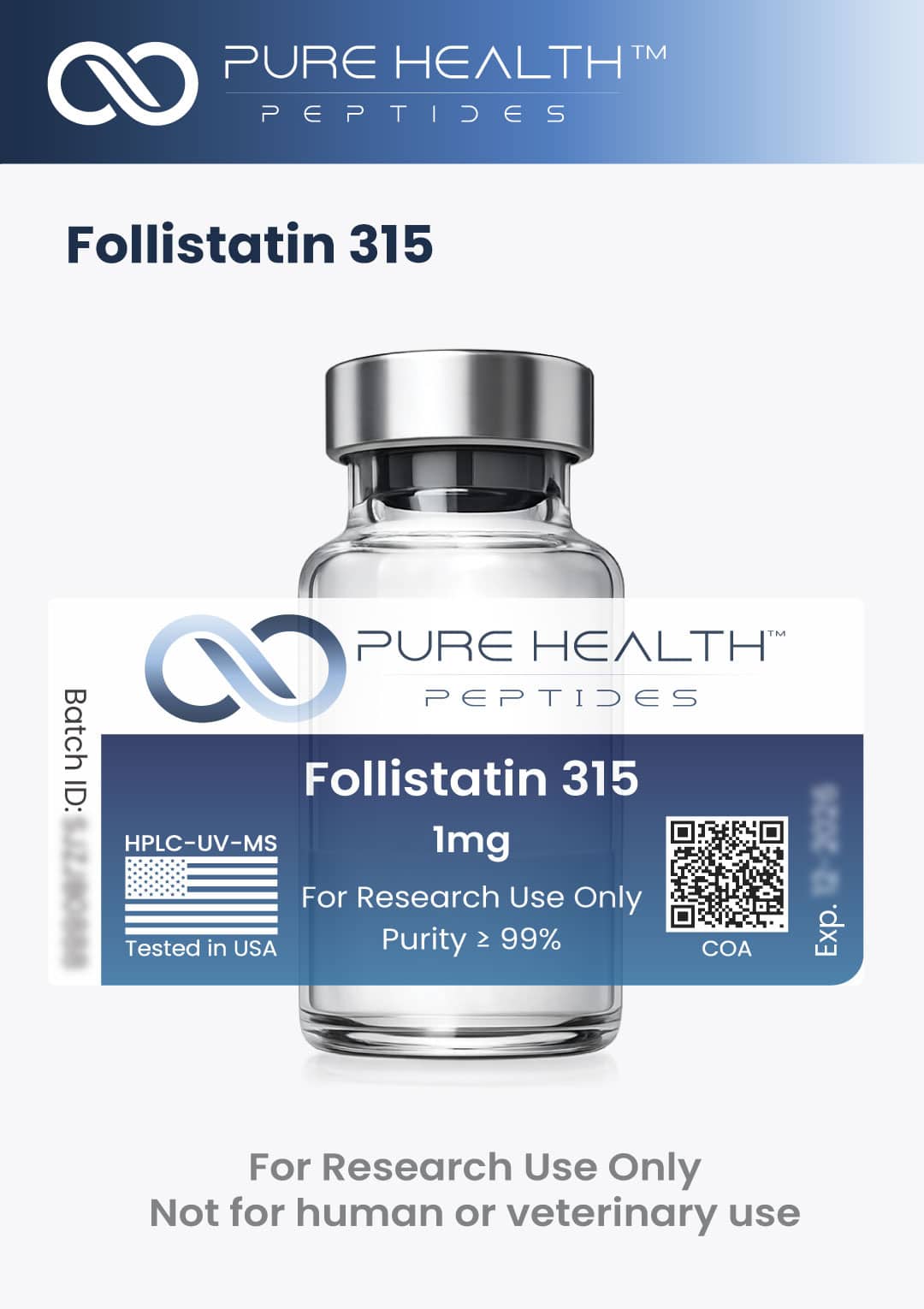
- Pure Health Peptides supplies Follistatin 315 as a lyophilized Vial (1 mg). Every lot is routed through independent, ISO/IEC 17025-accredited testing by Ethos Analytics as the exclusive testing partner.
Introduction
Follistatin research sits at the center of a well-defined signaling problem: how growth-regulating factors of the TGF-beta superfamily are held in check. Activin and myostatin are two such factors, and follistatin is one of the principal endogenous proteins that binds and neutralizes them. Because myostatin acts as a brake on skeletal muscle mass, the study of follistatin has become closely tied to the study of muscle growth regulation, and follistatin-derived research materials are used as tools to probe that pathway in preclinical systems.
This article treats Follistatin 315 in that context. It describes the follistatin protein family and the isoform distinctions that the 315 designation refers to, the binding biology that connects follistatin to activin and myostatin, and the skeletal muscle research that follows from myostatin antagonism. Throughout, the framing is mechanistic and preclinical, consistent with the research-use context.
The Follistatin Protein Family and Its Isoforms
Follistatin is an activin-binding protein that exists in more than one form. The two most studied isoforms are FST288 and FST315, and the numbers refer to the length of the mature protein. The functional difference between them is largely a matter of localization: FST288 binds strongly to cell-surface heparan sulfate proteoglycans and acts locally, while FST315 has lower heparin affinity and is characterized as the freely circulating isoform.
Work distinguishing the isoforms showed that their biological activity depends on differential cell-surface binding and on their specificity for activin, myostatin, and bone morphogenetic proteins (Sidis et al., 2006), and related work described how the isoforms differ in biosynthesis and intracellular transport (Schneyer et al., 2005).
Follistatin 315 as a research material is a synthetic peptide fragment derived from this isoform context, prepared by solid-phase peptide synthesis rather than isolated from a biological source. Pure Health Peptides also lists a related Follistatin 344 product, which corresponds to a different follistatin designation and is a distinct research material rather than a different carrier of the same compound. For researchers mapping this small cluster, the useful point is that the follistatin products reference different isoform designations of the same parent protein family.
Follistatin, Activin, and Myostatin: TGF-beta Superfamily Antagonism
The mechanism that defines follistatin is high-affinity binding to specific TGF-beta superfamily ligands. Follistatin wraps around activin and neutralizes it, and it binds myostatin (GDF-8) in a comparable manner, preventing these ligands from engaging their receptors. The structural basis for this antagonism lies in the follistatin-type domains, which have been characterized for their contribution to myostatin and activin binding (Cash et al., 2012). By sequestering activin and myostatin, follistatin acts as an endogenous check on the signaling those ligands would otherwise drive.
This antagonism is what gives follistatin its research importance. Activin and myostatin signaling participate in a range of developmental and tissue-regulatory processes, and a protein that can selectively neutralize them provides a way to probe what happens when that signaling is reduced. In experimental systems, follistatin-derived materials are used precisely for that purpose, as tools to interrogate activin and myostatin pathways under controlled conditions.
Myostatin Inhibition and Skeletal Muscle Research
The most prominent application of follistatin research is in skeletal muscle biology, and it follows directly from the myostatin connection. Myostatin is a negative regulator of muscle mass, and foundational work established that reducing myostatin activity is associated with increased skeletal muscle in animal models, with follistatin identified as one of the endogenous antagonists capable of driving that effect (Lee and McPherron, 2001).
Because of this, follistatin-derived materials are widely used in preclinical skeletal muscle research as tools for examining the myostatin pathway and its role in the regulation of muscle mass.
The appropriate framing here is strictly mechanistic and preclinical. Follistatin 315 is studied as a research material for investigating myostatin and activin signaling in defined experimental systems and animal models, and its relevance sits within the growth and repair research theme covered in the cellular repair and regeneration overview. The research value lies in the pathway biology within defined preclinical systems.
Carrier Format and Verification
Follistatin 315 is supplied in a single carrier format, a lyophilized Vial at 1 mg, prepared by solid-phase peptide synthesis and provided as a lyophilized white to off-white powder. Because structural characterization and molecular weight for a derived fragment are defined per production lot, those values are reported on the lot-specific Certificate of Analysis rather than fixed on the label, which is the appropriate way to document a synthetic fragment whose exact specification is verified batch by batch.
Underneath the format is the verification chain. Pure Health Peptides does not manufacture the material; production is sourced from qualified third-party manufacturers, and the material is finished and tested domestically, as described on the Manufacturing Process page. Every lot is routed through independent, ISO/IEC 17025-accredited testing by Ethos Analytics as the exclusive testing partner, and each qualified lot’s Certificate of Analysis is published in the COA Library, in the vial section, retrievable by batch ID.
For a lyophilized vialed peptide, the appropriate panel extends beyond identity, purity, and quantity to include endotoxin and microbial limits, because contamination can enter downstream of synthesis through handling, lyophilization, vial filling, storage, and transit. The Testing Process page documents how that verification runs, and the same standard applies to every product in the Pure Health Peptides catalog.
Where Follistatin 315 Sits in Growth-Pathway Research
For researchers studying the control of growth-regulating signals, Follistatin 315 is a defined, follistatin-derived tool for probing the activin and myostatin pathways. Its research value rests on follistatin’s well-characterized biology: a protein that binds and neutralizes specific TGF-beta superfamily ligands, and in doing so removes a brake on processes those ligands restrain.
As myostatin and activin research continues in skeletal muscle and broader tissue-regulatory contexts, follistatin-derived materials remain central tools, and the distinction between the follistatin isoforms keeps the 315 designation a specific and useful reference point within that work.
Frequently Asked Questions
What is Follistatin 315?
Follistatin 315 is a synthetic, follistatin-derived peptide fragment prepared by solid-phase peptide synthesis and supplied as a lyophilized powder. It references the FST315 isoform of the follistatin protein, which is characterized as the freely circulating, lower-heparin-affinity isoform.
How does follistatin relate to myostatin and activin?
Follistatin binds and neutralizes activin and myostatin (GDF-8), two members of the TGF-beta superfamily, preventing them from engaging their receptors. This antagonism is the defining feature of follistatin biology.
Why is follistatin studied in skeletal muscle research?
Because myostatin is a negative regulator of skeletal muscle mass. Reducing myostatin activity is associated with increased muscle in animal models, and follistatin is one of the endogenous antagonists studied in that preclinical context.
How does Follistatin 315 differ from Follistatin 344?
They correspond to different follistatin designations and are distinct research materials, not different carrier formats of the same compound. Follistatin 315 references the FST315 isoform.
What carrier format is Follistatin 315 available in, and how is it verified?
A lyophilized vial (1 mg). Every lot is routed through independent, ISO/IEC 17025-accredited testing by Ethos Analytics, with a lot-specific Certificate of Analysis published in the COA Library.
References
- Sidis Y, Mukherjee A, Keutmann H, et al. Biological activity of follistatin isoforms and follistatin-like-3 is dependent on differential cell surface binding and specificity for activin, myostatin, and bone morphogenetic proteins. Endocrinology, 2006;147(7):3586-3597.
- Schneyer AL, et al. Differential biosynthesis and intracellular transport of follistatin isoforms and follistatin-like-3. Endocrinology, 2005.
- Cash JN, et al. Characterization of follistatin-type domains and their contribution to myostatin and activin A antagonism. Journal of Biological Chemistry, 2012.
- Lee SJ, McPherron AC. Regulation of myostatin activity and muscle growth. Proceedings of the National Academy of Sciences, 2001;98(16):9306-9311.
- International Organization for Standardization / International Electrotechnical Commission. ISO/IEC 17025:2017, General requirements for the competence of testing and calibration laboratories.