
FOR RESEARCH USE ONLY. The content provided in this article is for educational and informational purposes only and is based on published scientific literature. The compounds discussed are not approved by the FDA for human or veterinary use. They are strictly intended for laboratory research and in vitro experimentation. Pure Health Peptides does not endorse or encourage the use of these products outside of a controlled research setting.
PT-141 occupies a defined position within melanocortin receptor pathway research. The peptide is a synthetic analog descended from melanotan-II, with structural modifications producing an altered receptor affinity profile relative to the parent compound. The melanocortin pathway itself has been a substantial area of research across several decades, with the five receptors of the family characterized in cell biology, neuroscience, and metabolic signaling literature (Cone, 2006).
This article describes the melanocortin receptor family that PT-141 acts on, the structural and receptor-profile features that distinguish the molecule, the downstream signaling mechanisms under investigation, and the verification infrastructure relevant to PT-141 research material.
Research Snapshot
- PT-141 (also designated bremelanotide in chemical literature) is a cyclic seven-amino-acid peptide derived structurally from melanotan-II, which itself was developed as a synthetic analog of α-melanocyte-stimulating hormone (α-MSH) (Hadley & Hruby, 1997).
- In receptor binding studies, PT-141 has been characterized as an agonist of the melanocortin receptor family, with activity across MC3R and MC4R and altered relative affinity across the receptor family compared with the parent melanotan-II.
- The melanocortin receptor family comprises five G-protein-coupled receptors (MC1R through MC5R), each with distinct tissue distribution and downstream signaling roles. α-MSH is the canonical endogenous ligand most extensively studied across the family (Gantz & Fong, 2003).
- Mechanistic research on PT-141 has investigated cAMP signaling downstream of MC3R and MC4R engagement, with broader interest in the hypothalamic neuropeptide signaling networks in which these receptors operate (Cone, 2006).
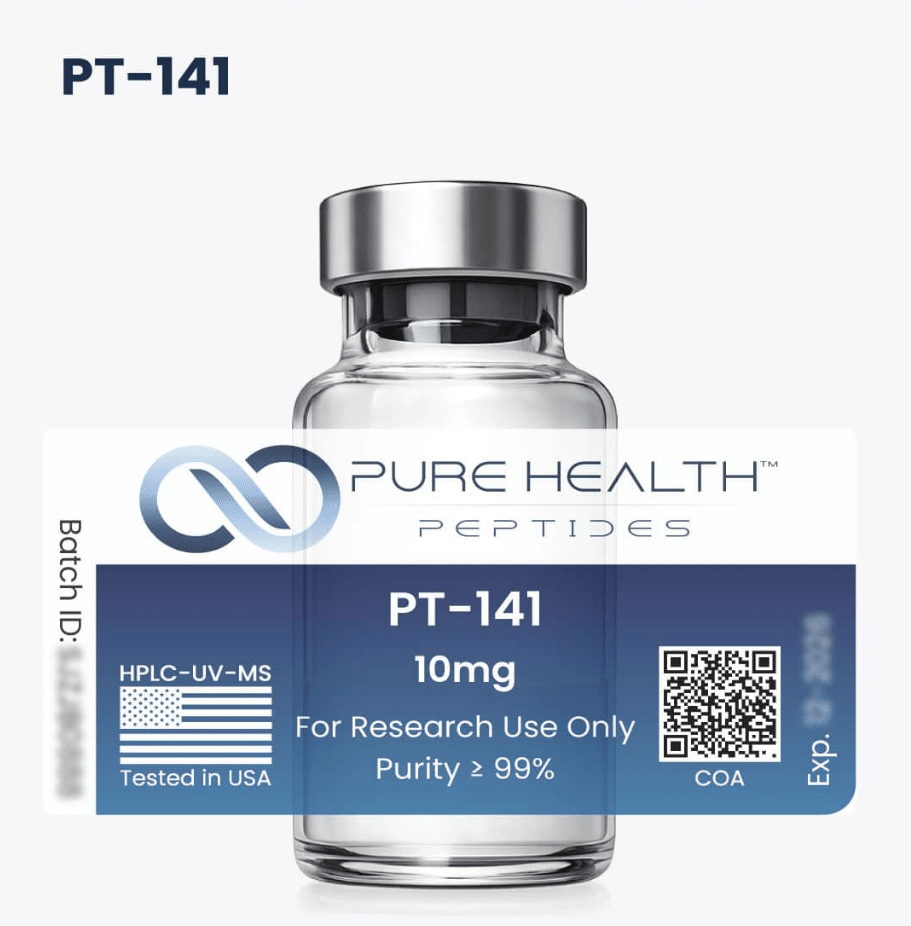
- Pure Health Peptides offers PT-141 as a Vial format and a Liquid format research peptide. Material is sourced from qualified third-party manufacturers; the verification chain — independent lot-level testing by Ethos Analytics under ISO/IEC 17025 accreditation — is what Pure Health Peptides owns and stands behind across the catalog.
Introduction
PT-141 occupies a defined position within melanocortin receptor pathway research. The peptide is a synthetic analog descended from melanotan-II, with structural modifications producing an altered receptor affinity profile relative to the parent compound. The melanocortin pathway itself has been a substantial area of research across several decades, with the five receptors of the family characterized in cell biology, neuroscience, and metabolic signaling literature (Cone, 2006).
This article describes the melanocortin receptor family that PT-141 acts on, the structural and receptor-profile features that distinguish the molecule, the downstream signaling mechanisms under investigation, and the verification infrastructure relevant to PT-141 research material.
The Melanocortin Receptor Family
The melanocortin receptor family consists of five G-protein-coupled receptors, designated MC1R through MC5R. Each receptor has a distinct primary tissue distribution. MC1R is most prominently expressed in melanocytes and has been characterized in the context of pigmentation signaling. MC2R is expressed in the adrenal cortex and acts as the receptor for adrenocorticotropic hormone (ACTH) in the hypothalamic-pituitary-adrenal axis. MC3R and MC4R are expressed predominantly in the central nervous system, with MC4R particularly concentrated in hypothalamic nuclei involved in energy homeostasis. MC5R has been characterized in exocrine glands and peripheral tissues (Gantz & Fong, 2003; Yang, 2011).
The canonical endogenous ligand for the melanocortin family is α-melanocyte-stimulating hormone (α-MSH), a 13-amino-acid peptide cleaved from the precursor protein pro-opiomelanocortin (POMC). Other endogenous ligands include β-MSH, γ-MSH, and ACTH, each with differing affinities across the receptor family. Endogenous antagonists are also part of the system — most notably agouti-related peptide (AgRP), which modulates MC3R and MC4R signaling in central circuits.
All five melanocortin receptors signal predominantly through Gαs coupling, activating adenylate cyclase and producing cyclic AMP (cAMP) as the principal second messenger. Downstream cAMP signaling activates protein kinase A and triggers a range of cellular responses that vary by receptor subtype and tissue context.
PT-141’s Structural Origin and Receptor Profile
PT-141 is a cyclic peptide containing seven amino acid residues. Its structural origin can be traced through melanotan-II, an earlier synthetic α-MSH analog developed in the 1980s (Hadley & Hruby, 1997; Hruby et al., 1995). Melanotan-II itself was created as a conformationally stabilized α-MSH analog with broad melanocortin receptor agonism. PT-141 emerged from subsequent structure-activity research aimed at altering the receptor affinity profile across the melanocortin family compared with the parent compound.
The amino acid sequence of PT-141 includes a cyclic core stabilized by an amide bond between residues, producing the conformationally restricted structure characteristic of melanocortin agonists. The cyclic structure both increases receptor binding affinity and confers metabolic stability relative to linear peptide alternatives. The inclusion of a non-natural amino acid residue and the N-terminal modification further distinguish PT-141 from the parent α-MSH sequence.
In receptor binding assays, PT-141 has demonstrated nanomolar affinity for MC3R and MC4R. The published literature on PT-141’s MC1R/MC3R/MC4R selectivity is mixed — receptor binding studies report varied affinity profiles, and PT-141 retains substantial activity across the broader receptor family rather than acting as a cleanly selective agonist. The relative affinity profile across the receptor family is altered compared with the parent melanotan-II, but characterizing PT-141 as broadly “selective” overstates the consensus in the published literature.
Downstream Signaling and Pathway Research
Following MC3R or MC4R engagement, PT-141 has been characterized as triggering the standard melanocortin receptor signaling cascade: Gαs coupling, adenylate cyclase activation, cAMP production, and downstream protein kinase A activation. The cellular response to this signaling cascade has been studied extensively in heterologous expression systems, where the receptor and downstream effectors can be examined in isolation (Yang, 2011).
In intact research models, MC4R signaling has been a focal point because of its central role in hypothalamic neuropeptide circuits. The hypothalamic arcuate nucleus contains both POMC-expressing neurons (which produce α-MSH endogenously) and AgRP-expressing neurons (which antagonize melanocortin receptor signaling). These circuits have been extensively characterized in energy homeostasis research, where MC4R signaling has been linked to satiety pathway regulation in rodent models (Cone, 2006).
MC3R has been less extensively characterized than MC4R but has also been implicated in metabolic and neuropeptide signaling contexts. The receptor’s autoreceptor-like expression on POMC neurons themselves has been a subject of investigation, with research models exploring feedback regulation of melanocortin tone via MC3R signaling.
Beyond the central nervous system context, PT-141 research sits within the broader melanocortin pathway landscape, including the interaction between melanocortin signaling and other neuropeptide systems. The compound’s research footprint in cellular signaling literature is built primarily around receptor-level characterization and downstream cAMP-mediated effects.
Sourcing, Verification, and Lot-Level Testing
PT-141 in the Pure Health Peptides catalog is sourced from qualified third-party manufacturers as strictly compliant research material. Pure Health Peptides does not manufacture peptide material directly. What Pure Health Peptides owns and stands behind across the catalog is the third-party verification chain.
Every production lot is independently tested by Ethos Analytics under ISO/IEC 17025 accreditation, with the result published as a lot-specific Certificate of Analysis. The standard COA panel reports peptide identity verified by HPLC and mass spectrometry per USP <621>, purity, quantity, heavy metals screening by ICP-MS per USP <233>, endotoxin testing per USP <85>, and microbiological screening per USP <61> and USP <62>. Lot-level COAs are accessible through the publicly browsable COA Library (Vial COAs | Capsule COAs | Liquid COAs).
PT-141 is available in two carrier formats: a Vial format suitable for reconstitution at the point of research use, and a Liquid format pre-formulated for workflows where ready-prepared material is appropriate. Both formats follow identical lot-level COA discipline, with each carrier verified independently as part of the release protocol.
The Direction of PT-141 Research
Melanocortin receptor pathway research continues to develop, with active investigation into the structural basis of receptor subtype selectivity, the regulation of melanocortin tone in hypothalamic circuits, and the broader integration of melanocortin signaling with other neuropeptide systems. PT-141 sits within this research landscape as one of the more studied synthetic melanocortin agonists available for mechanistic work, and continues to be referenced in receptor-pharmacology and signaling research. Quality verification is foundational to that research. Receptor-level signaling assays require high-confidence material identity and purity, and the lot-level COA infrastructure described above is built to support that requirement.
FOR RESEARCH USE ONLY. The content provided in this article is for educational and informational purposes only and is based on published scientific literature. The compounds discussed are not approved by the FDA for human or veterinary use. They are strictly intended for laboratory research and in vitro experimentation. Pure Health Peptides does not endorse or encourage the use of these products outside of a controlled research setting.
Frequently Asked Research Questions
What is PT-141, and how is it structurally related to α-MSH?
PT-141 is a cyclic seven-amino-acid peptide derived from melanotan-II, which was itself developed as a synthetic α-MSH analog. The cyclic structure confers conformational stability and increased receptor binding affinity, while structural modifications produce an altered receptor affinity profile across the melanocortin receptor family compared with the parent melanotan-II.
Which melanocortin receptors does PT-141 act on?
In receptor binding studies, PT-141 has been characterized as an agonist with activity across the melanocortin receptor family, particularly MC3R and MC4R. The published literature on its precise selectivity profile across MC1R, MC3R, and MC4R is mixed; the compound retains substantial activity across the broader receptor family rather than acting as a cleanly selective agonist.
What downstream signaling does PT-141 trigger in research models?
Like other melanocortin receptor agonists, PT-141 has been characterized as triggering Gαs coupling, adenylate cyclase activation, cAMP production, and downstream protein kinase A signaling. The cellular and tissue-level consequences vary by receptor subtype and by the research model in which signaling is examined.
What carrier formats is PT-141 available in?
PT-141 is offered in Vial format (suitable for reconstitution at the point of research use) and Liquid format (pre-formulated for ready-prepared workflows). Both follow the standard lot-level COA discipline applied across the Pure Health Peptides catalog.
Where is PT-141 in the Pure Health Peptides catalog sourced from?
PT-141 is sourced from qualified third-party manufacturers as strictly compliant research material. Pure Health Peptides does not manufacture peptide material directly. The third-party verification chain — independent ISO/IEC 17025-accredited testing of every production lot — is what Pure Health Peptides owns and stands behind.
References
Scientific Literature
- Hadley, M.E. & Hruby, V.J. (1997). Discovery and Development of Novel Melanogenic Drugs: Melanotan-I and Melanotan-II. Pharmaceutical Biotechnology.
- Hruby, V.J., et al. (1995). Cyclic Lactam α-Melanotropin Analogues. Journal of Medicinal Chemistry.
- Gantz, I. & Fong, T.M. (2003). The Melanocortin System. American Journal of Physiology — Endocrinology and Metabolism, 284(3), E468–E474.
- Cone, R.D. (2006). Studies on the Physiological Functions of the Melanocortin System. Endocrine Reviews, 27(7), 736–749.
- Yang, Y. (2011). Structure, function and regulation of the melanocortin receptors. European Journal of Pharmacology, 660(1), 125–130.
Regulatory and Pharmacopeial Standards
- United States Pharmacopeia. Chapter <621>: Chromatography.
- United States Pharmacopeia. Chapter <233>: Elemental Impurities — Procedures.
- United States Pharmacopeia. Chapter <85>: Bacterial Endotoxins Test.
- United States Pharmacopeia. Chapter <61>: Microbiological Examination of Nonsterile Products — Microbial Enumeration Tests.
- United States Pharmacopeia. Chapter <62>: Microbiological Examination of Nonsterile Products — Tests for Specified Microorganisms.
- International Organization for Standardization. ISO/IEC 17025:2017 — General requirements for the competence of testing and calibration laboratories.