FOR RESEARCH USE ONLY. The content provided in this article is for educational and informational purposes only and is based on published scientific literature. The compounds discussed are not approved by the FDA for human or veterinary use. They are strictly intended for laboratory research and in vitro experimentation. Pure Health Peptides does not endorse or encourage the use of these products outside of a controlled research setting.
Research Snapshot
- Thymosin Alpha-1 (Tα1) is a 28-amino-acid peptide originally isolated from thymic fraction 5 (Goldstein et al., 1977); it has been the subject of extensive preclinical and in vitro research into immunomodulatory signaling.
- Mechanistic literature has investigated its action on plasmacytoid dendritic cell maturation via Toll-like receptor 9 (TLR9) pathway activation and the downstream effects on T-cell function in research models (Romani et al., 2004).
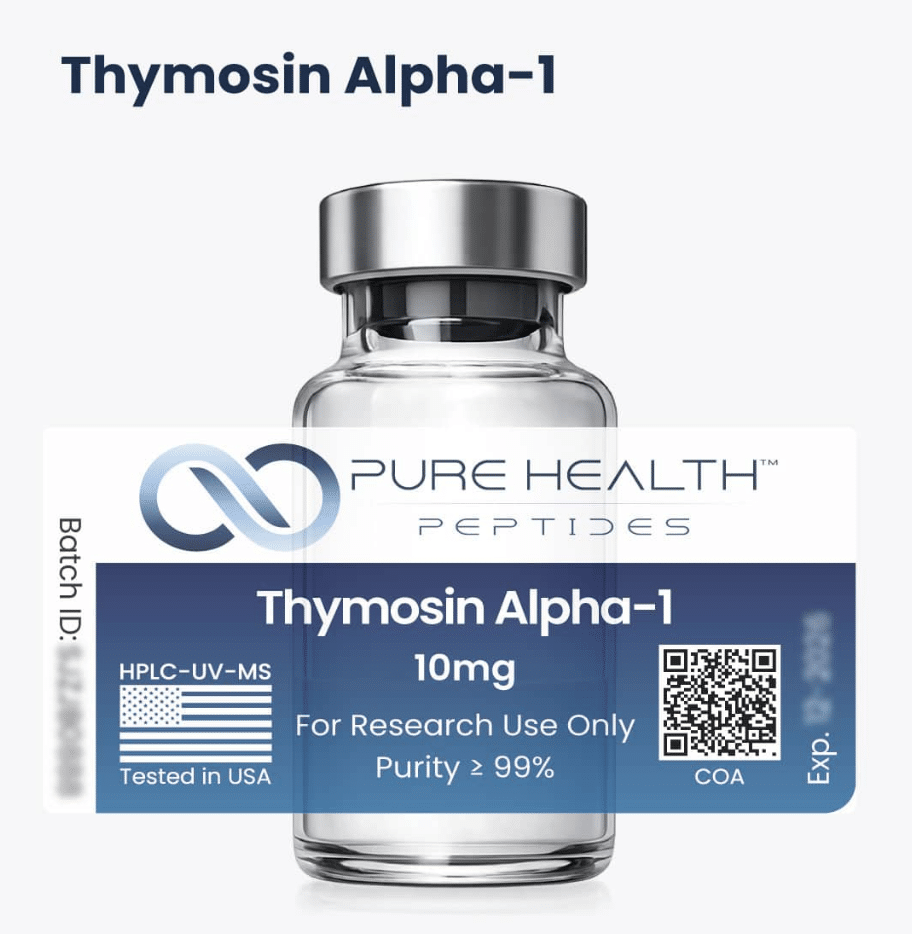
- Pure Health Peptides offers Thymosin Alpha-1 as a Vial format compound and as one of four components in the GLOW-Plus blend, alongside BPC-157, GHK-Cu, and TB-500.
- Material is sourced from qualified third-party manufacturers as strictly compliant research material. The verification chain — independent third-party testing by Ethos Analytics under ISO/IEC 17025 accreditation — is what Pure Health Peptides owns and stands behind across the catalog.
- The standard COA panel covers identity, purity, quantity, heavy metals, endotoxin, and microbiological limits. Endotoxin and microbial limits testing were added to the standard panel in May 2026 — a particularly meaningful addition for immunomodulator research, where endotoxin contamination would itself confound immune signaling assays.
Introduction
Thymosin Alpha-1 is among the most extensively studied immunomodulator peptides in preclinical and in vitro research literature. Originally identified as part of thymic fraction 5 — a heterogeneous extract of bovine thymus — Tα1 was subsequently isolated, sequenced, and characterized as a 28-amino-acid peptide with N-terminal acetylation. In the decades since, the mechanistic literature has accumulated a substantial body of work examining its modulatory effects on dendritic cells, T-cell function, and broader immune signaling networks in research models.
For research applications, the analytical demands placed on immunomodulator peptide material are particularly stringent. The compound under investigation must be identified with high confidence, and the material must be free of contaminants that would themselves generate immune signals — a category that includes bacterial endotoxin, microbial metabolites, and process-related impurities. This article describes the mechanistic territory under investigation for Thymosin Alpha-1 and the verification infrastructure relevant to research use of this compound class.
Structural and Mechanistic Background
Thymosin Alpha-1 is a 28-amino-acid peptide with the sequence Ac-SDAAVDTSSEITTKDLKEKKEVVEEAEN. The N-terminal acetylation is a notable structural feature and arises during natural processing from prothymosin alpha. The peptide is small relative to many biologically active peptides, and its compact structure has been the focus of structure-function research aimed at understanding which residues are responsible for its observed activity in immune signaling assays (Goldstein et al., 1977).
Mechanistic research has predominantly focused on Tα1’s interaction with the innate immune system. In preclinical and in vitro models, the peptide has been investigated as an activator of Toll-like receptor 9 (TLR9) pathway signaling in plasmacytoid dendritic cells (Romani et al., 2004). The mechanism is more nuanced than simple receptor agonism — the published literature describes Tα1 as a modulator of TLR9 pathway activity rather than a classical agonist in the receptor-binding sense.
TLR9 pathway engagement triggers a signaling cascade involving MyD88 recruitment, downstream NF-κB activation, and the production of type I interferons. This signaling axis has been characterized extensively in cellular models, and the literature has built a coherent picture of how Tα1’s action at the dendritic cell level propagates into broader adaptive immune effects in research systems.
Immunomodulatory Pathways Under Investigation
Research models examining Thymosin Alpha-1 have investigated several pathway-level mechanisms. T-cell maturation has been a recurring focus: in vitro studies have observed effects on the differentiation of thymocyte populations, on the maturation of peripheral T cells, and on the cytokine profile of stimulated T-cell populations (King & Tuthill, 2016).
Interferon-gamma (IFN-γ) signaling is another well-studied pathway in the Tα1 literature. Preclinical models have demonstrated upregulated IFN-γ production from natural killer cells and from CD4+ T-cell populations following Tα1 exposure. The mechanistic literature has connected this effect to upstream dendritic cell activation, with Tα1-mediated dendritic cell maturation driving IL-12 release and downstream IFN-γ induction (Wang et al., 2018).
Regulatory T-cell (Treg) modulation has also been characterized in research models. Studies have observed shifts in the balance between regulatory and effector T-cell populations following Tα1 exposure, with mechanisms attributed to changes in dendritic cell antigen presentation and to direct effects on Treg differentiation pathways.
Across these mechanistic axes, the research literature consistently describes Tα1 as a modulator rather than a global activator or suppressor. The observed effects are context-dependent and reflect the state of the immune system in the research model at the time of exposure.
Why Immunomodulator Research Demands Stringent Verification
Research on immunomodulator peptides places unusual demands on material verification. The compound under investigation must be confirmed for identity, purity, and content. Beyond these standard verifications, immunomodulator research carries an additional concern: contamination by substances that themselves produce immune signals.
Bacterial endotoxin (lipopolysaccharide, or LPS) is the most prominent of these concerns. LPS is a potent agonist of Toll-like receptor 4 (TLR4) and triggers powerful inflammatory signaling at concentrations as low as picograms per milliliter. In an immunomodulator research workflow, any LPS contamination in the test material would confound the experimental signal — observed immune effects could reflect the LPS rather than the peptide under investigation. For this reason, endotoxin testing is a foundational verification for any peptide used in immune signaling research, regardless of how the peptide itself was produced.
A common assumption in the research peptide market has been that chemically synthesized peptides, which do not involve bacterial expression systems, are inherently free of endotoxin risk. The current understanding is more nuanced. While the chemical synthesis itself does not introduce endotoxin, the downstream production chain does present contamination vectors: handling during purification, lyophilization steps, vial filling, storage conditions, and transit each carry potential contamination routes. Endotoxin and microbial limits testing therefore remain meaningful verifications for chemically synthesized peptide material — and are particularly relevant for immunomodulator compounds where contamination would directly interfere with the research signal.
Pure Health Peptides added endotoxin and microbiological limits testing to the standard Certificate of Analysis panel in May 2026. Every production lot of Thymosin Alpha-1 — and of every other compound in the catalog — is now tested for endotoxin and microbial content as part of the standard release protocol, in addition to identity, purity, quantity, and heavy metals.
Sourcing, Verification, and the GLOW-Plus Blend
Thymosin Alpha-1 in the Pure Health Peptides catalog is sourced from qualified third-party manufacturers as strictly compliant research material in Vial format. Pure Health Peptides does not manufacture peptide material directly. What Pure Health Peptides owns and stands behind across the catalog is the third-party verification chain.
Every production lot of Thymosin Alpha-1 is independently tested by Ethos Analytics under ISO/IEC 17025 accreditation, with the result published as a lot-specific Certificate of Analysis. The standard COA panel reports peptide identity verified by HPLC and mass spectrometry per USP <621>, purity, quantity, heavy metals screening by ICP-MS per USP <233>, endotoxin testing per USP <85>, and microbiological screening per USP <61> and USP <62>. Lot-level COAs are accessible through the publicly browsable COA Library (Vial COAs | Capsule COAs | Liquid COAs).
Thymosin Alpha-1 also appears as one of four components in the GLOW-Plus blend, a multi-peptide formulation that combines BPC-157, GHK-Cu, TB-500, and Thymosin Alpha-1. Blend products carry their own verification considerations: each individual component must be confirmed independently for identity and content, and the formulation as a whole must be verified for absence of cross-component interference. The GLOW-Plus blend follows the same lot-level COA discipline applied to individual compounds, with each lot’s COA accessible through the same COA Library.
The Direction of Thymosin Alpha-1 Research
Mechanistic research on Thymosin Alpha-1 continues to develop, with active investigation into the structure-function relationship of the 28-residue sequence, into the receptor-level kinetics of TLR9 pathway engagement, and into the broader signaling networks downstream of dendritic cell activation. Quality verification is foundational to that research.
Meaningful interpretation of immunomodulatory signaling data requires confidence that the compound under investigation is exactly what the label says and is free of contaminants that would themselves trigger immune responses. The verification infrastructure described above — third-party ISO/IEC 17025-accredited testing with lot-level COAs covering identity, purity, quantity, heavy metals, endotoxin, and microbial content — is built to support that level of analytical confidence.
FOR RESEARCH USE ONLY. The content provided in this article is for educational and informational purposes only and is based on published scientific literature. The compounds discussed are not approved by the FDA for human or veterinary use. They are strictly intended for laboratory research and in vitro experimentation. Pure Health Peptides does not endorse or encourage the use of these products outside of a controlled research setting.
Frequently Asked Research Questions
What is the proposed mechanism of action of Thymosin Alpha-1 in preclinical research models?
The peptide has been characterized in mechanistic literature as an activator of TLR9 pathway signaling in plasmacytoid dendritic cells. Downstream effects observed in research models include dendritic cell maturation, IL-12 release, IFN-γ induction from natural killer and T-cell populations, and broader modulation of T-cell differentiation pathways.
Why does Thymosin Alpha-1 research require particularly stringent endotoxin testing?
Bacterial endotoxin (LPS) is itself a potent immune signal acting through TLR4. Any LPS contamination in immunomodulator research material would confound experimental observations because the observed immune effects could reflect the endotoxin rather than the peptide. Endotoxin testing per USP <85> is therefore a foundational verification for any peptide used in immune signaling research.
How is the identity of Thymosin Alpha-1 verified at the lot level?
Peptide identity is confirmed by HPLC coupled with mass spectrometry per USP <621>, comparing the measured monoisotopic mass against the theoretical mass calculated from the 28-amino-acid sequence. The result is reported on the lot-specific Certificate of Analysis produced by Ethos Analytics under ISO/IEC 17025 accreditation.
How does Thymosin Alpha-1 relate to the GLOW-Plus blend?
Thymosin Alpha-1 is one of four components in the GLOW-Plus blend, alongside BPC-157, GHK-Cu, and TB-500. The blend follows the same lot-level COA discipline applied to individual compounds in the catalog, with each component verified independently as part of the release protocol.
Where is Thymosin Alpha-1 in the Pure Health Peptides catalog sourced from?
Thymosin Alpha-1 is sourced from qualified third-party manufacturers as strictly compliant research material. Pure Health Peptides does not manufacture peptide material directly. What Pure Health Peptides owns and stands behind across the catalog is the third-party verification chain — independent ISO/IEC 17025-accredited testing of every production lot by Ethos Analytics.
References
Scientific Literature
- Goldstein, A.L., et al. (1977). Thymosin alpha 1: isolation and sequence analysis of an immunologically active thymic polypeptide. Proceedings of the National Academy of Sciences, 74(2), 725–729.
- Romani, L., et al. (2004). Thymosin alpha 1 activates dendritic cells for antifungal Th1 resistance through Toll-like receptor signaling. Blood, 103(11), 4232–4239.
- King, R. & Tuthill, C. (2016). Immune modulation with thymosin alpha 1 treatment. Vitamins and Hormones, 102, 151–178.
- Wang, F., et al. (2018). Mechanisms underlying the immunomodulatory action of thymosin α1. Journal of Translational Medicine.
Regulatory and Pharmacopeial Standards
- United States Pharmacopeia. Chapter <85>: Bacterial Endotoxins Test.
- United States Pharmacopeia. Chapter <621>: Chromatography.
- United States Pharmacopeia. Chapter <233>: Elemental Impurities — Procedures.
- United States Pharmacopeia. Chapter <61>: Microbiological Examination of Nonsterile Products — Microbial Enumeration Tests.
- United States Pharmacopeia. Chapter <62>: Microbiological Examination of Nonsterile Products — Tests for Specified Microorganisms.
- International Organization for Standardization. ISO/IEC 17025:2017 — General requirements for the competence of testing and calibration laboratories.