DISCLAIMER
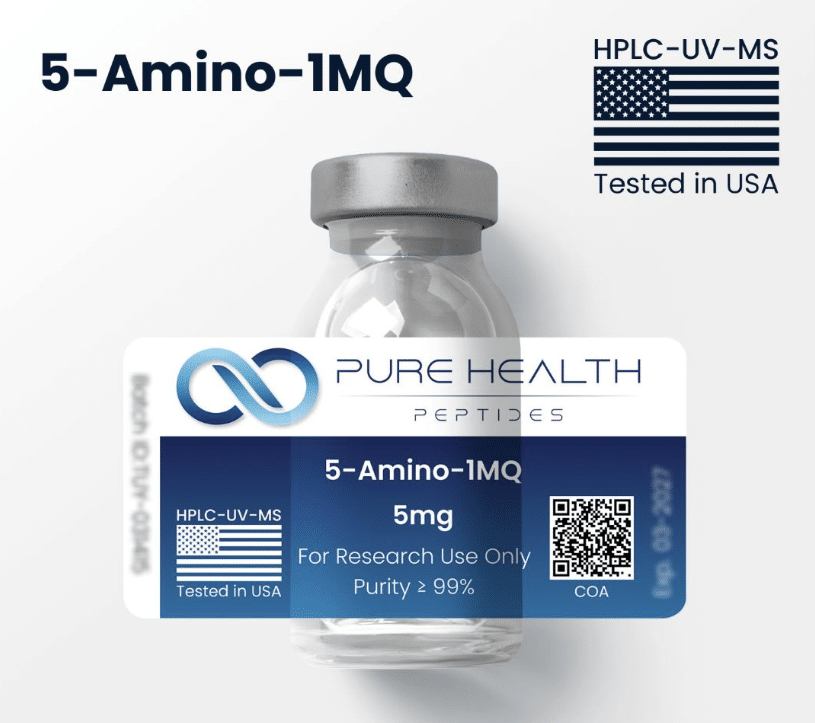
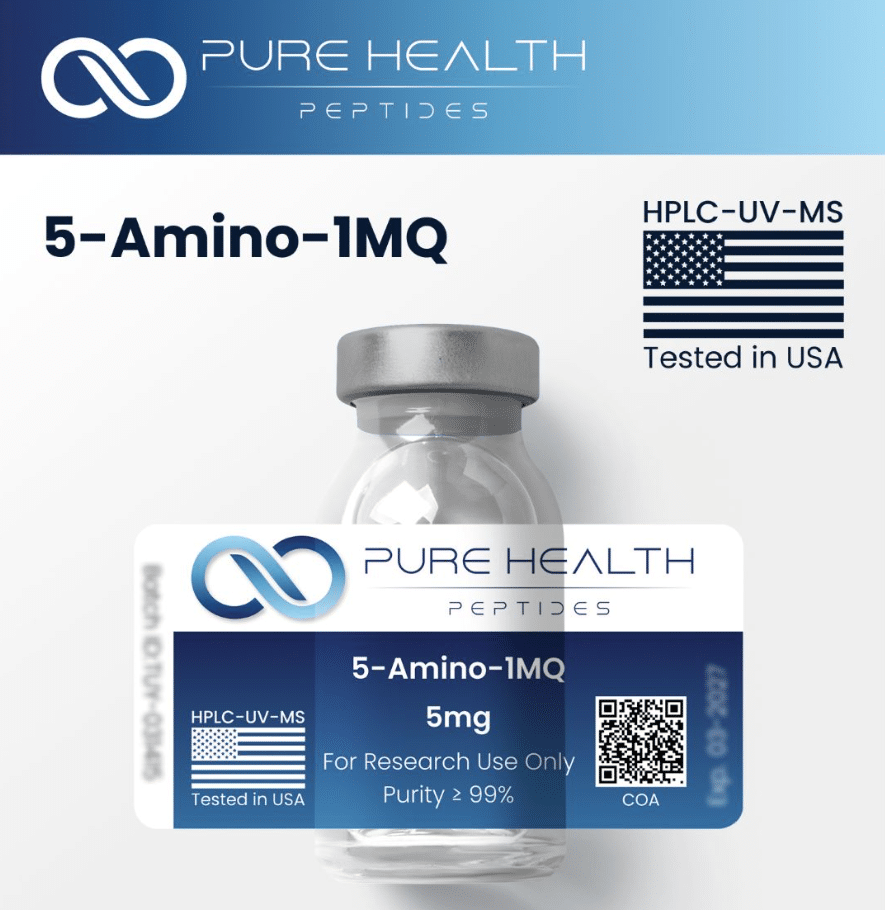
FOR RESEARCH USE ONLY. The content provided in this article is for educational and informational purposes only and is based on published scientific literature. The compounds discussed, including 5-Amino-1MQ, are not approved by the FDA for human or veterinary use. They are strictly intended for laboratory research and in vitro experimentation. Pure Health Peptides does not endorse or encourage the use of these products outside of a controlled research setting.
What Recent 5‑Amino‑1MQ Data Shows
- Enzymatic Inhibition: 5-Amino-1MQ is a small molecule inhibitor of Nicotinamide N-methyltransferase (NNMT), an enzyme often overexpressed in the adipose tissue of subjects with metabolic dysfunction.
- NAD+ Restoration: By blocking NNMT, 5-Amino-1MQ prevents the degradation of Nicotinamide, allowing it to be recycled back into NAD+ via the salvage pathway.
- Adipocyte Metabolism: Research suggests that this restoration of NAD+ increases the basal metabolic rate of white adipose tissue cells without the use of central nervous system stimulants.
- Muscle Function: Beyond fat cells, recent studies indicate that NNMT inhibition may rejuvenate aged muscle stem cells (satellite cells), promoting better regeneration and contractile force in older models.
The Small Molecule with Big Potential
In the vast library of metabolic research compounds, 5-Amino-1MQ (5-amino-1-methylquinolinium) stands out. Unlike peptides which mimic hormones, 5-Amino-1MQ is a synthetic small molecule designed for a specific intracellular target: the enzyme NNMT.
Initially developed by researchers at the University of Texas Medical Branch, this compound was created to address a specific biochemical bottleneck. Scientists observed that as organisms age or gain excess weight, their fat cells (adipocytes) produce excessive amounts of NNMT. This enzyme acts as a “sink” for cellular energy precursors.
By synthesizing a molecule that could permeate the cell membrane and selectively inhibit NNMT, researchers discovered they could fundamentally alter the metabolic profile of the cell. This has made 5-Amino-1MQ a primary subject of investigation for studies involving obesity, Type 2 diabetes models, and age-related muscular atrophy.
The NNMT Problem and the NAD+ Solution
To understand why researchers study 5-Amino-1MQ, one must understand the “Salvage Pathway.”
Cells rely on a molecule called NAD+ (Nicotinamide Adenine Dinucleotide) to fuel their mitochondria. NAD+ is essential for converting nutrients into ATP energy. The body naturally recycles spent energy molecules back into NAD+ using the salvage pathway.
However, the enzyme NNMT disrupts this process. It takes Nicotinamide (the raw material for NAD+) and methylates it, effectively removing it from the salvage loop. The result is twofold:
- Lower NAD+: The cell has less fuel for metabolism.
- Methyl Depletion: The body loses valuable methyl groups needed for other processes.
Research published in Biochemical Pharmacology demonstrated that treating cells with 5-Amino-1MQ effectively blocks this “leak.” It inhibits NNMT, forcing Nicotinamide back into the salvage pathway. The result is a significant boost in intracellular NAD+ levels, which in turn activates sirtuins (SIRT1) – proteins known to regulate cellular health and metabolism.
Metabolic Effects in White Adipose Tissue
White Adipose Tissue (WAT) is the primary storage site for energy in the body. In metabolic research models, high-fat diets typically lead to hypertrophy (enlargement) of WAT cells and a slowdown in their metabolic rate.
In a landmark study, diet-induced obese mice treated with 5-Amino-1MQ showed a roughly 7% reduction in body mass over 11 days without any change in food intake. This is a critical distinction in metabolic research. Most weight-loss compounds work by suppressing appetite like GLP-1 (C). 5-Amino-1MQ appeared to work by increasing the energy expenditure of the fat cells themselves.
Researchers hypothesize that the elevated NAD+ levels increase “futile cycling” – a process where cells burn energy to maintain electrochemical gradients rather than storing it as lipid droplets. This mechanism is currently being compared to mitochondrial uncoupling agents in various bioenergetic studies.
Muscle Satellite Cells and Aging
While initially targeted at fat, NNMT inhibitors have shown surprising potential in muscle tissue. Muscle regeneration relies on satellite cells (stem cells). As organisms age, these cells become “senescent” (dormant) and less capable of repairing damage.
Research has found that aged muscle stem cells have high levels of NNMT activity. By using 5-Amino-1MQ to inhibit this enzyme, scientists were able to “rejuvenate” these cells in elderly mice. The treated cells showed improved fusion capacity and generated muscle fibers with greater contractile force.
This dual-action potential, shrinking fat cells while supporting muscle repair, makes 5-Amino-1MQ a unique candidate for “body recomposition” research, distinct from purely anabolic agents like MGF.
Closing Perspective on 5‑Amino‑1MQ
5-Amino-1MQ represents a shift in metabolic research from “hormonal manipulation” to “cellular optimization.” By targeting the NNMT enzyme, it addresses a fundamental inefficiency in the metabolism of obese and aged cells. Its ability to restore NAD+ flux links it directly to the growing field of mitochondrial medicine.
Whether studied for its potential to shrink white adipose tissue or restore the regenerative capacity of aged muscle, 5-Amino-1MQ is establishing itself as a cornerstone compound in the study of cellular bioenergetics.
Common Questions in 5-Amino-1MQ Research
Is 5-Amino-1MQ a stimulant?
No. In research settings, 5-Amino-1MQ does not show affinity for adrenergic receptors or increase heart rate/blood pressure in the way that compounds like caffeine, ephedrine, or clenbuterol do. Its mechanism is strictly enzymatic (NNMT inhibition).
What is the bioavailability of 5-Amino-1MQ?
Because it is a small molecule and not a fragile peptide chain, 5-Amino-1MQ exhibits excellent membrane permeability and oral bioavailability. This allows research protocols to utilize [Capsules] rather than injections, simplifying long-term administration studies in rodent models.
Does it affect methylation?
Yes, theoretically in a positive way. By blocking NNMT, 5-Amino-1MQ prevents the “wasting” of methyl groups. This is hypothesized to preserve the body’s methyl pool, which is essential for DNA methylation and epigenetic regulation. This connects it to longevity research involving [Epithalon] and other epigenetic modifiers.
Can it be combined with other metabolic agents?
Researchers often investigate 5-Amino-1MQ in combination with precursors like Nicotinamide Riboside (NR) or NMN. The logic is synergistic: provide the raw material (NR/NMN) while simultaneously blocking the leak (5-Amino-1MQ) to maximize cellular NAD+ levels.
References
- Neelakantan, H., et al. (2018). “Chemical modification of a specific inhibitor of nicotinamide N-methyltransferase to generate a membrane-permeable prodrug.” Journal of Medicinal Chemistry, 61(3), 1366-1371.
- Kraus, D., et al. (2014). “Nicotinamide N-methyltransferase knockdown protects against diet-induced obesity.” Nature Medicine, 20(4), 398-403.
- Neelakantan, H., et al. (2019). “Small molecule nicotinamide N-methyltransferase inhibitor activates senescent muscle stem cells and improves regenerative capacity of aged skeletal muscle.” Biochemical Pharmacology, 163, 481-492.
- Sperber, H., et al. (2015). “The metabolome regulates the epigenetic landscape during naive-to-primed human embryonic stem cell transition.” Nature Cell Biology, 17(12), 1523-1535.
- Pissios, P. (2017). “Nicotinamide N-Methyltransferase: A Novel Regulator of Metabolic Homeostasis.” Trends in Endocrinology & Metabolism, 28(5), 340-353.